
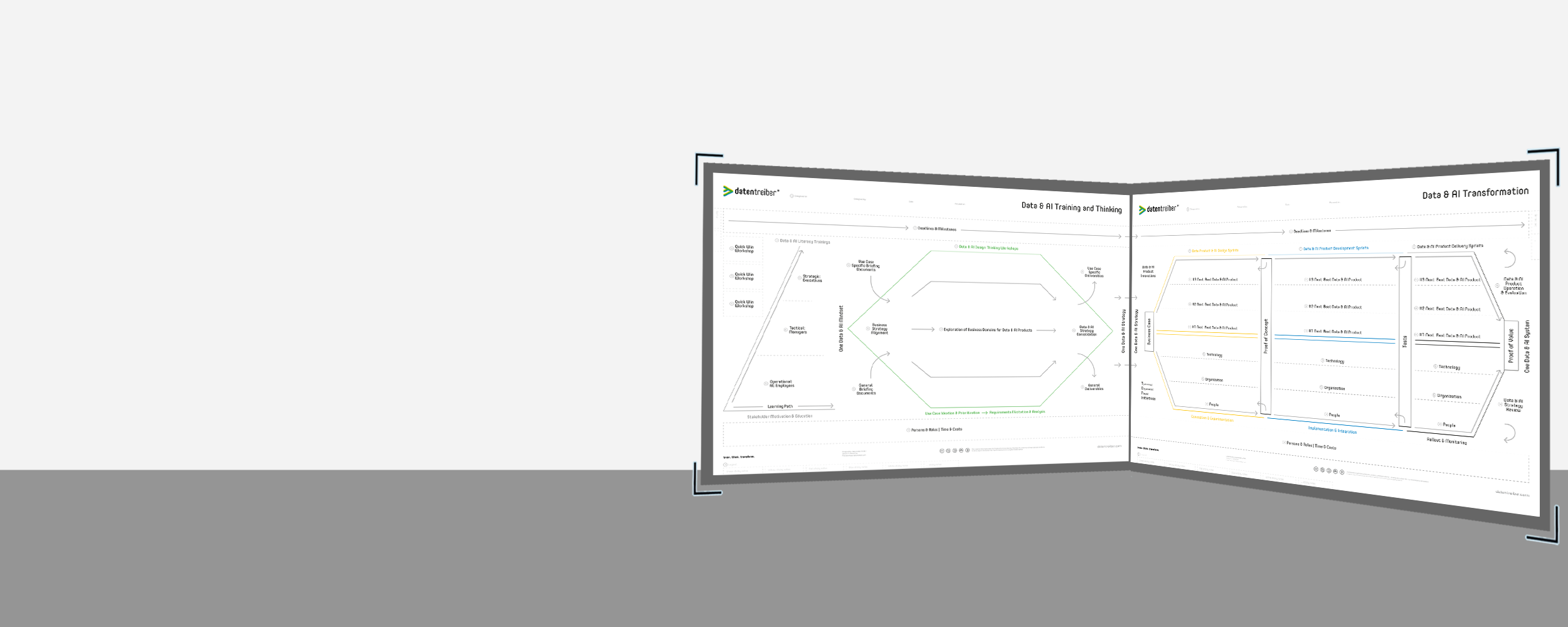
From Learning to Implementation
Data & AI Training and Thinking Canvas
Data & AI Transformation Canvas
By leveraging these two canvases together you create a complete roadmap that ensures your data & AI initiatives are practical, impactful, and truly integrated into the core of your business.
What Is the Data & AI Training and Thinking, and the Data & AI Transformation Canvas?
These two complementary canvases guide your organization through every phase of a data & AI journey—from building foundational knowledge and designing a coherent strategy, to implementing AI products and adapting internal structures.
- Data & AI Training and Thinking Canvas
- Purpose: Lays out the path for initial workshops, quick wins, and literacy trainings, followed by design thinking sessions that produce a user-centric and value-oriented data & AI strategy.
- Scope: Defines deadlines, milestones, and responsibilities during the train. and think. stages, ensuring your team gains the essential knowledge and strategic clarity required for subsequent transformation.
- Data & AI Transformation Canvas
- Purpose: Translates the newly formed strategy into tangible outcomes, detailing the development, delivery, and integration of data & AI products.
- Scope: Synchronizes design, development, and deployment sprints for data & AI solutions with the TOP (Technology, Organization, People) initiatives needed to support them. This helps maintain alignment between product innovation and internal change throughout the transform. stage.
By using both canvases together, you create a cohesive roadmap that supports skill-building, strategy formation, product innovation, and organizational adaptation—all essential for successfully embedding data and AI in your business.
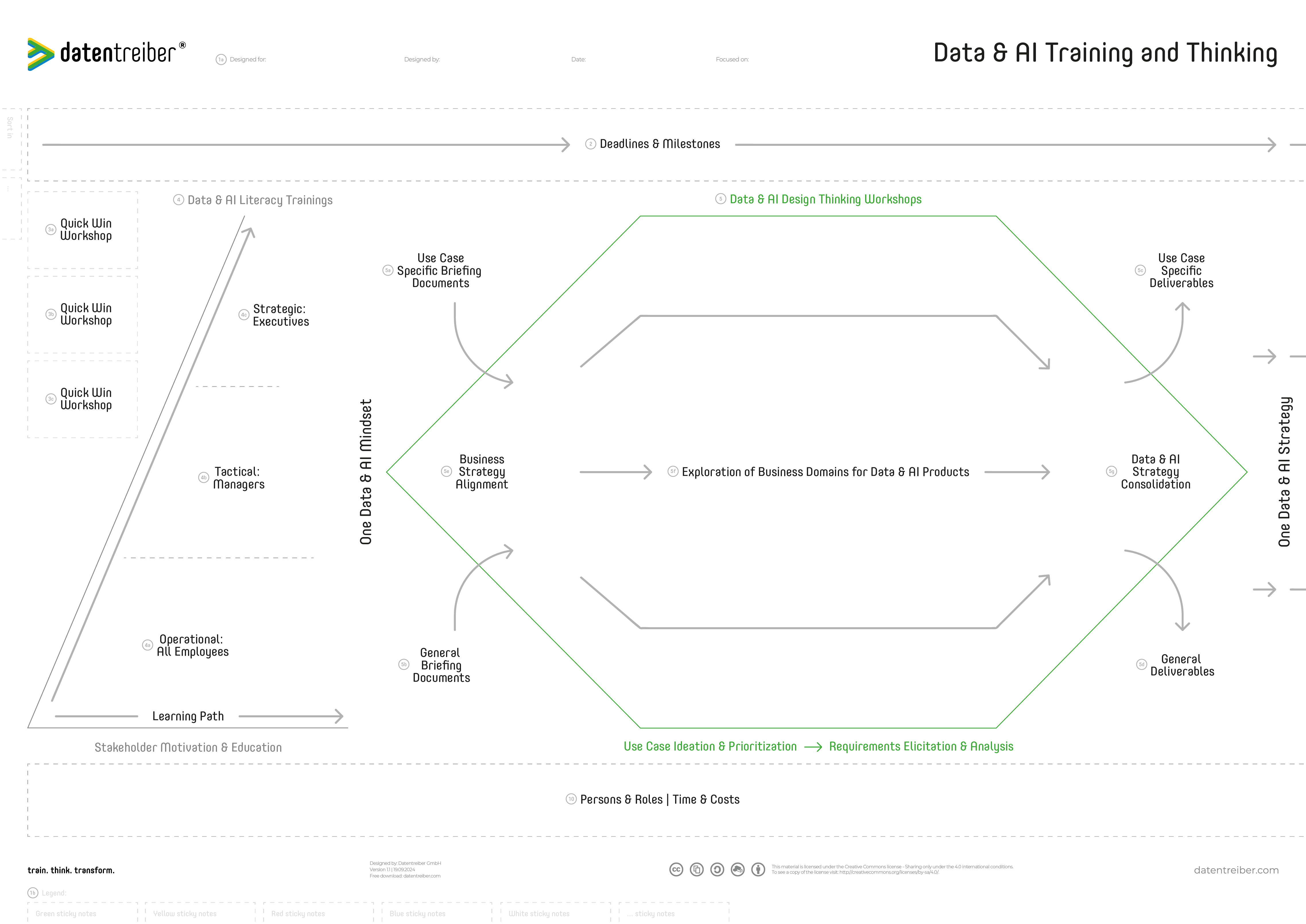
Data & AI Training and Thinking Canvas is available for free under a Creative Commons license: You may use and modify the canvas as long as you cite Datentreiber in particular as the source.
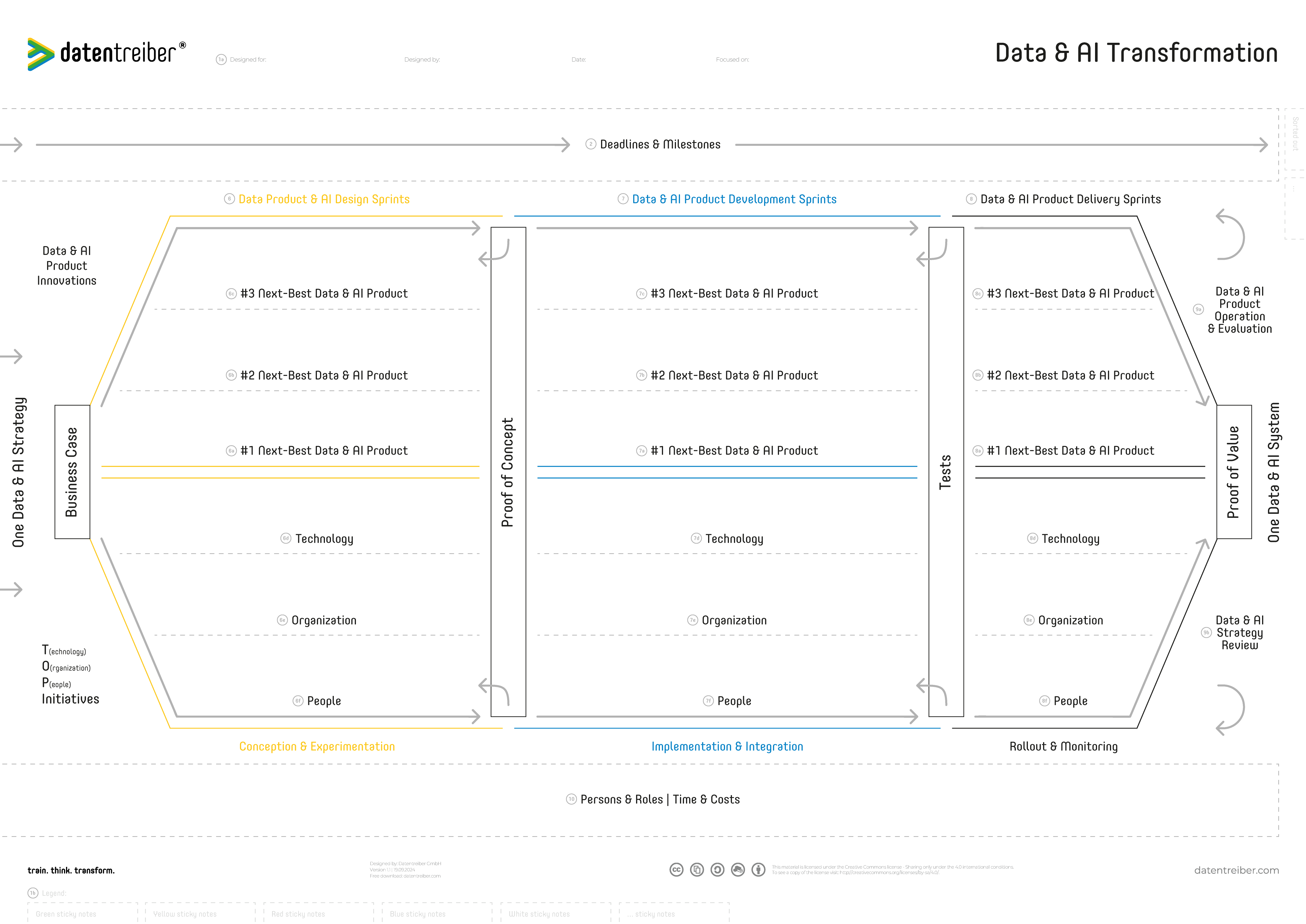
Data & AI Transformation Canvas is available for free under a Creative Commons license: You may use and modify the canvas as long as you cite Datentreiber in particular as the source.
When to Use the Data & AI Training and Thinking Canvas
- Starting Out with Data & AI:
If your organization is new to data and AI or to Datentreiber’s Data & AI Business Design method, use this canvas to plan “quick win” workshops that deliver immediate value and spark interest. - Building Data & AI Literacy:
Whenever you need structured, organization-wide training—whether for executives, managers, or technical staff—this canvas schedules and aligns the sessions needed to build a shared understanding of AI’s potential. - Designing a Holistic Strategy:
Once foundational knowledge is in place, the canvas supports design thinking workshops where stakeholders co-create a user-centric and value-oriented data & AI strategy that sets priorities and defines deliverables. - Before the Implementation Stage: When you are in the first two stages of your transformational journey in becoming a fully integrated data & AI business, you can use the canvas to map and plan your progress and get an consolidated overview of where you stand and where to go.
When to Use the Data & AI Transformation Canvas
- Moving Beyond Strategy into Execution:
After designing a holistic data & AI strategy, use this canvas to plan product sprints and parallel TOP initiatives—ensuring that each product concept can be effectively built, deployed, and maintained. - Coordinating Organizational Adaptation:
If your company must update its technology stack, refine organizational structures, or develop personnel capabilities to support AI products, the Transformation Canvas helps synchronize these efforts with product innovation. - Tracking Implementation Milestones and Results:
Use this canvas to manage deadlines, gatekeepers (like Proof of Concept and Proof of Value), and iterative sprints—verifying each product’s alignment with your overall business objectives before scaling it further.
How Do I Use the Canvases?
Description coming soon….

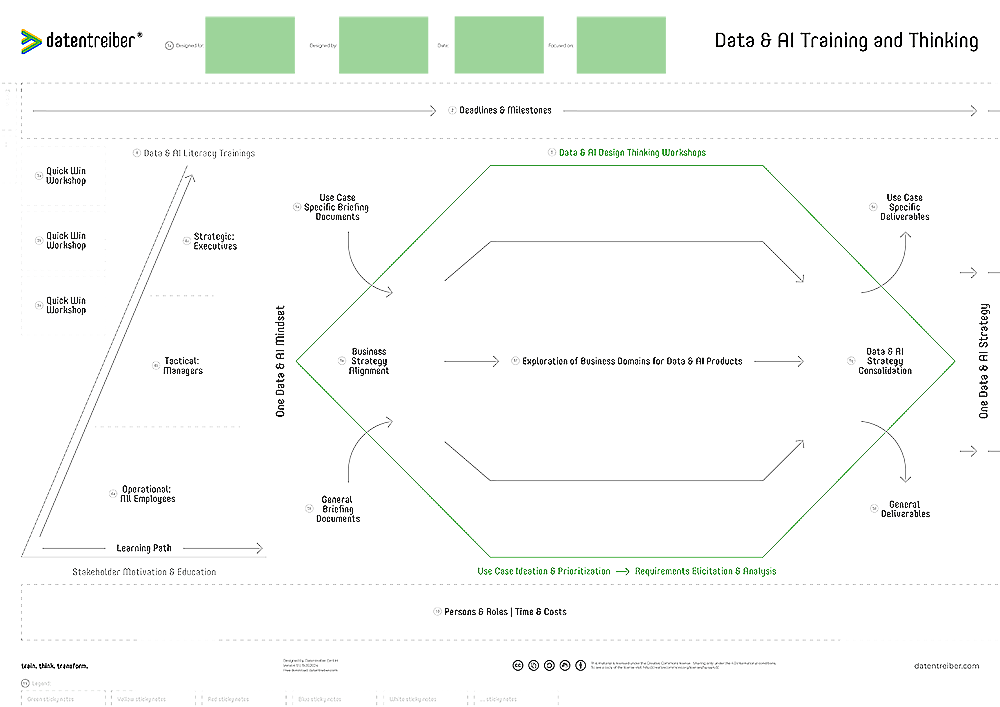
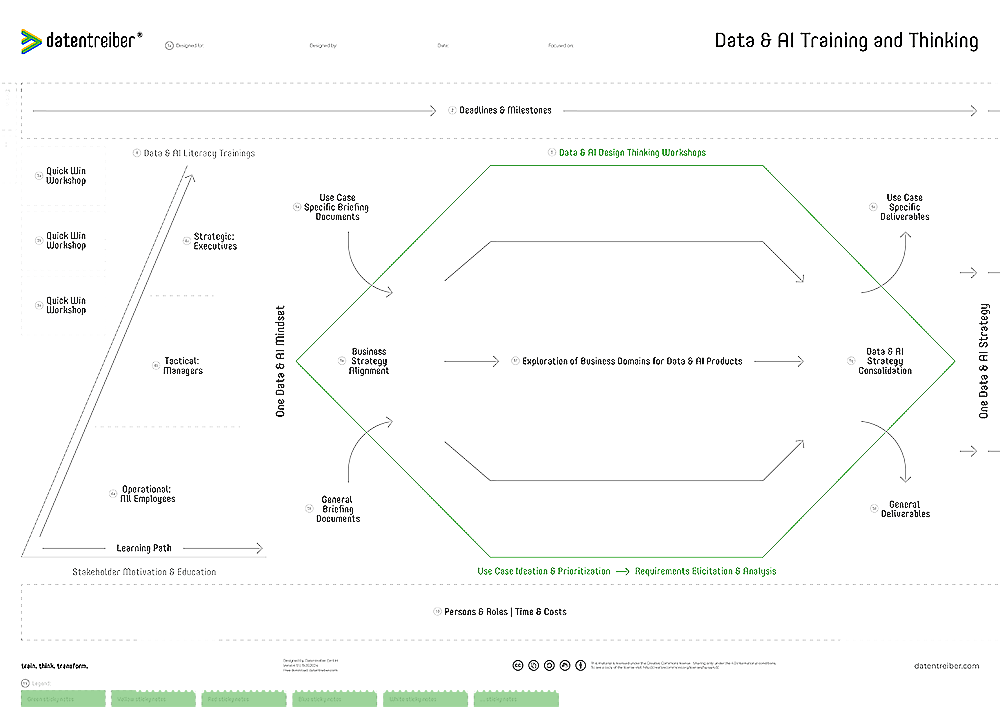

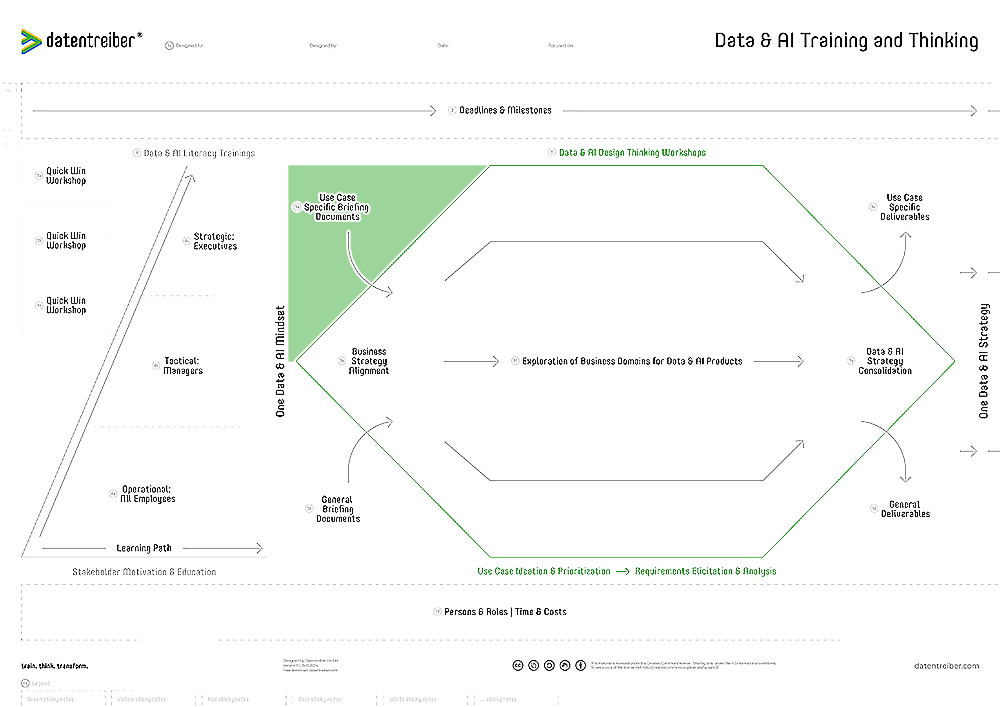
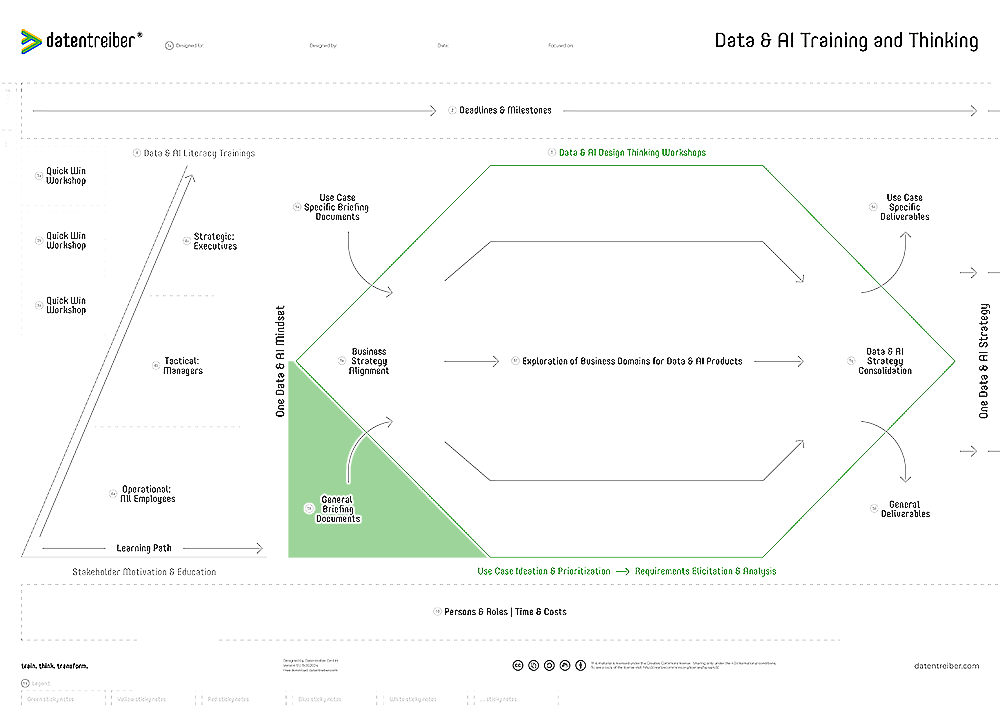

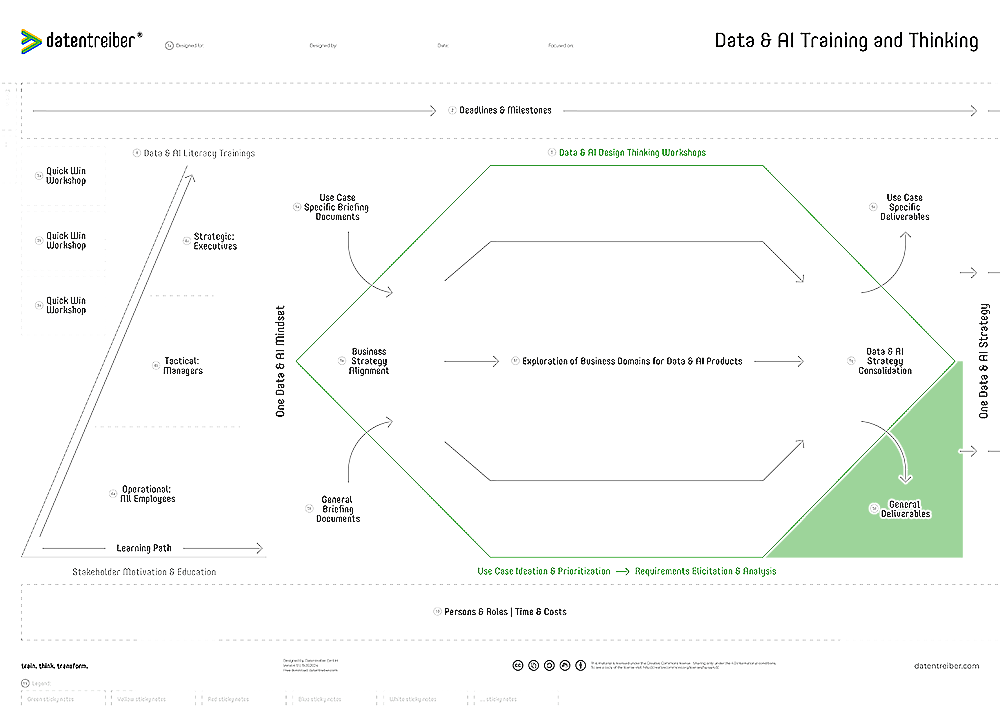
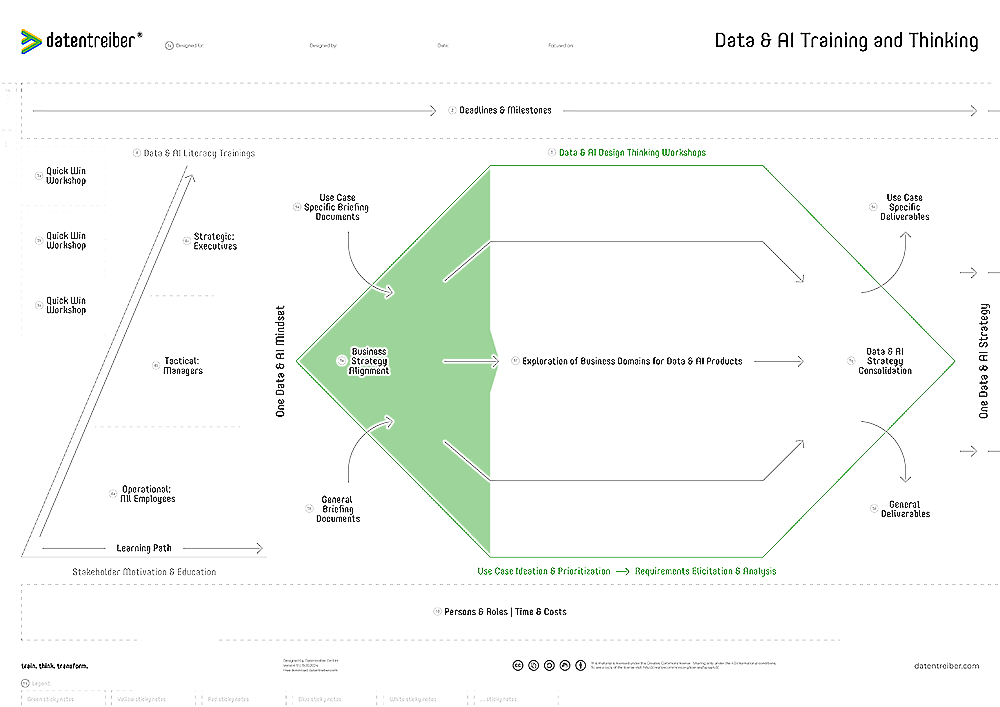

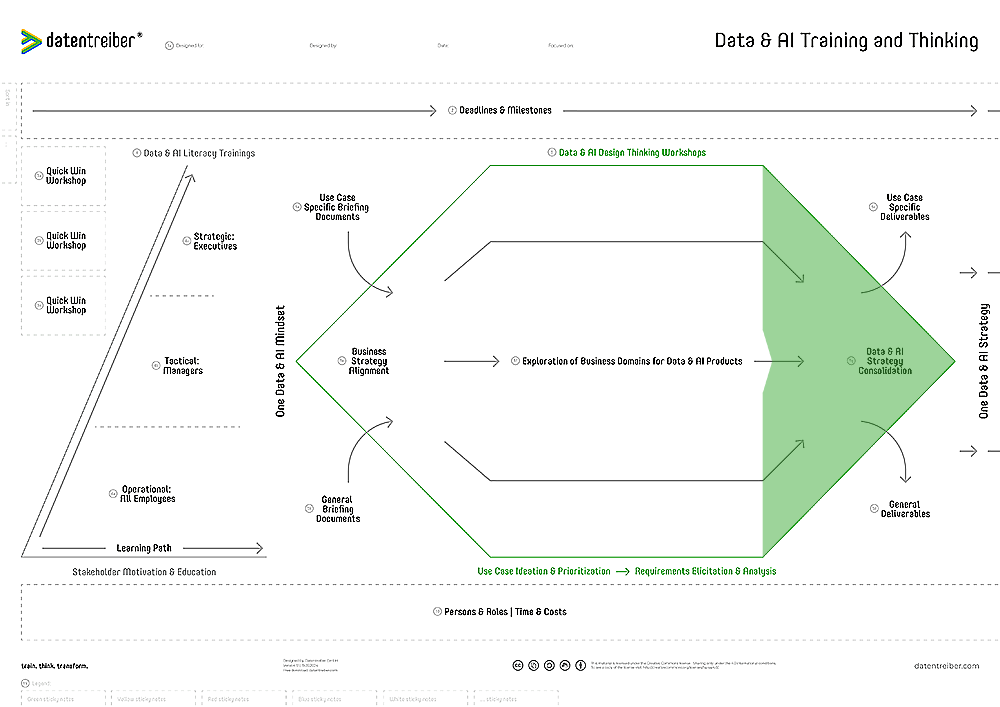
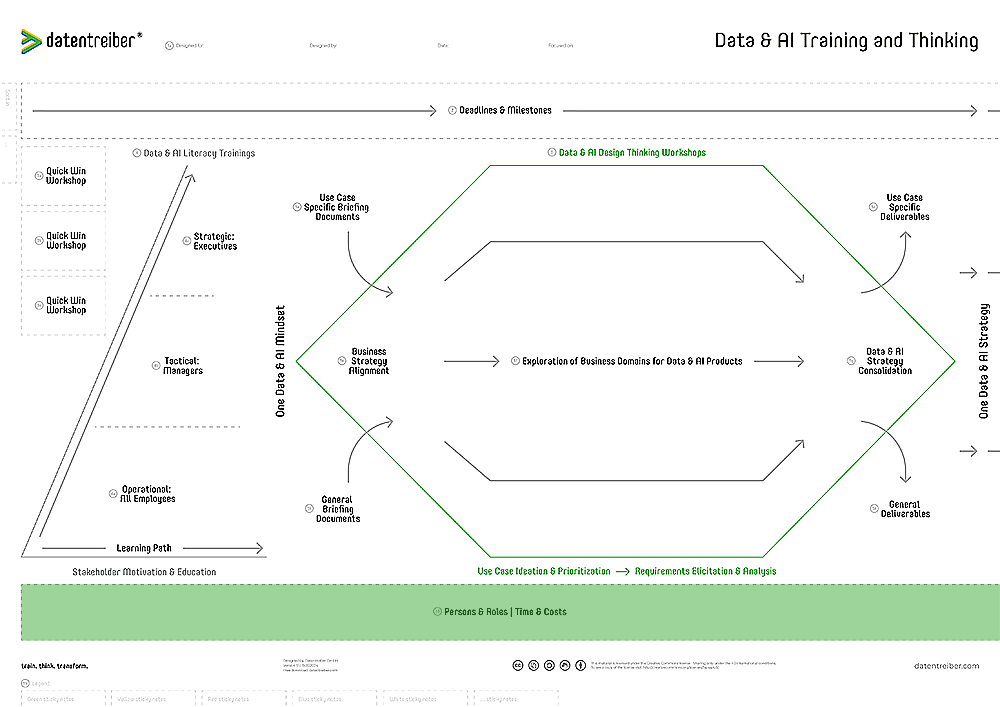
Canvas 1: Data & AI Training and Thinking
- 1a Header (Canvas 1)
- 1b Footer (Canvas 1)
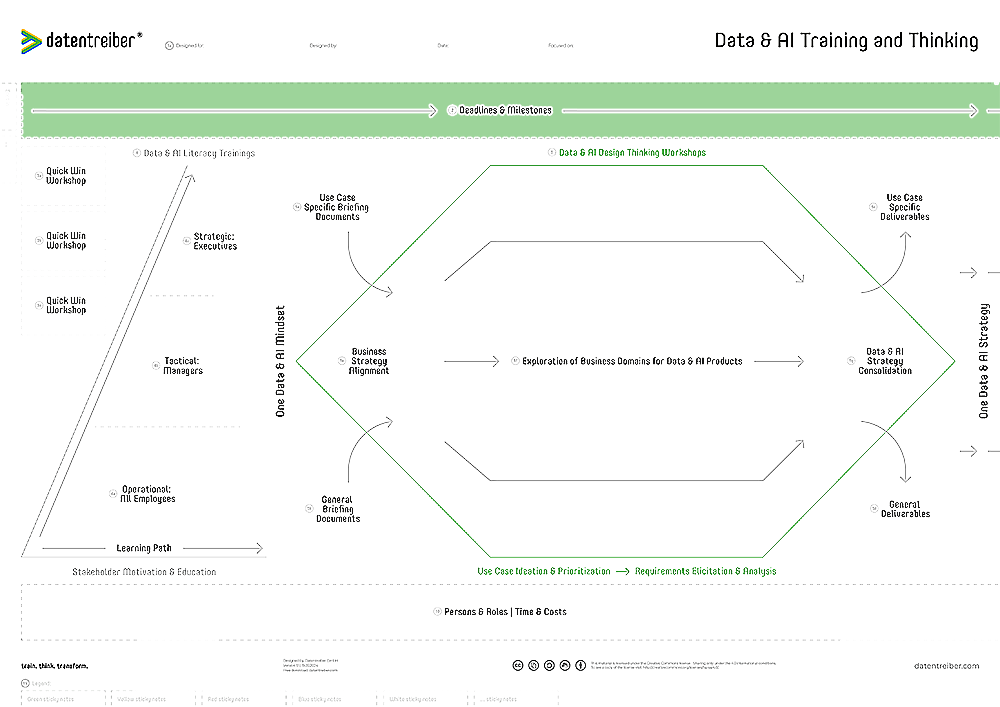
- 2 Deadlines & Milestones (Canvas 1)
- 3 Quick Win Workshops (Canvas 1)
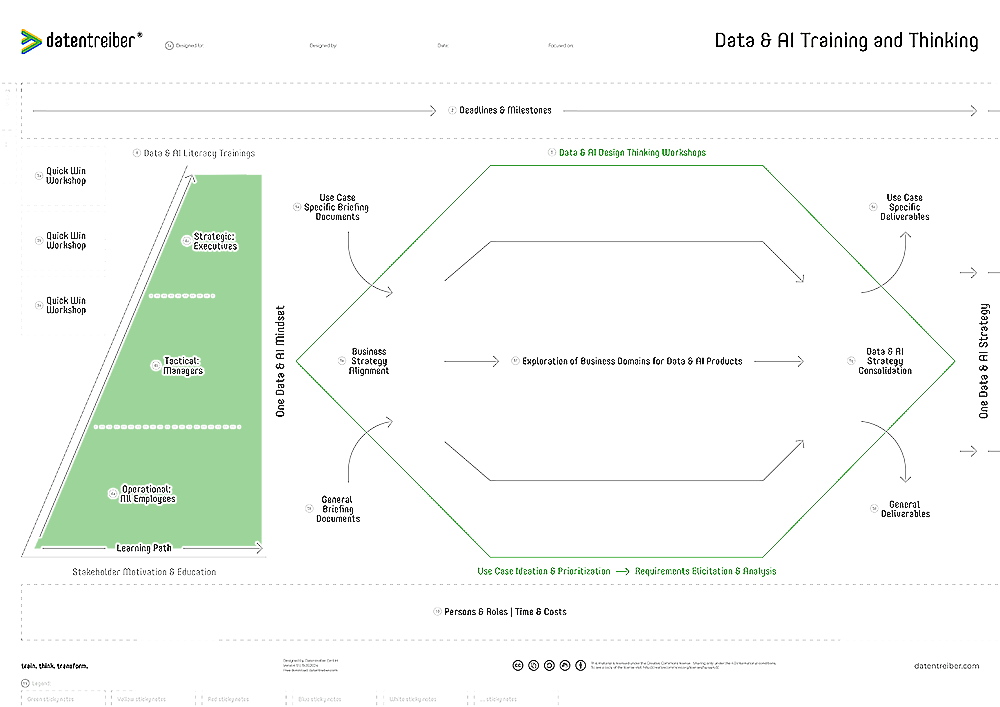
- 4 Data & AI Literacy Trainings
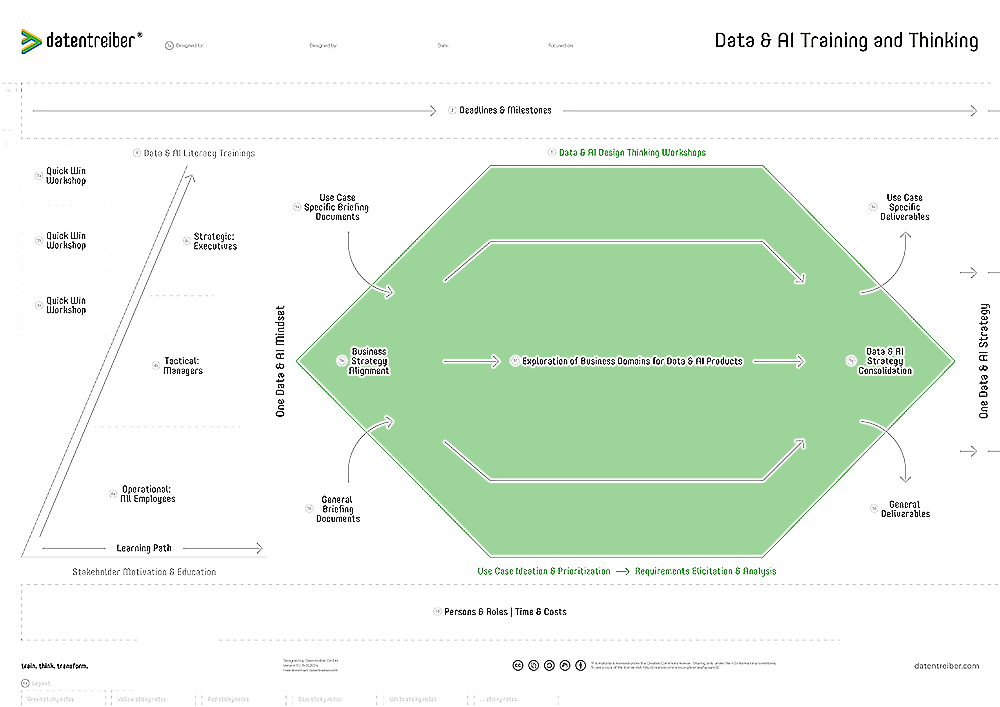
- 5 Data & AI Design Thinking Workshops
- 5a Use Case Specific Briefing Docs
- 5b General Briefing Docs
- 5c Use Case Specific Deliverables
- 5d General Deliverables
- 5e Business Strategy Alignment
- 5f Exploration of Business Domains
- 5g Data & AI Strategy Consolidation
- 10 Persons & Roles / Time & Costs
1a Header (Canvas 1)
The header defines the content of the canvas and should consist of the following information:
- Designed for: Which organization (company, department, team, etc.) does the content of the canvas concern?
- Designed by: Which organization (company, department, team, etc.) created the content?
- Date: When was the content created or last updated?
- Focused on: On which area/topic/case/etc. does the content of this canvas focus?
There should be no copies of the same canvas with identical headers, i.e., the header clearly identifies a version of the canvas (copy) and documents the current status of its content.
1b Footer (Canvas 1)
The footer explains the coloring of the sticky notes (and other formatting) on the canvas.
For each sticky note color, there should be an identically colored or formatted sticky note on the legend with a title explaining this specific sticky note category.
2 Deadlines & Milestones (Canvas 1)
Which milestones should be reached by which deadlines?
- Milestones are used to monitor progress, i.e., to determine whether you are on the right path and will reach your destination at the right time.
- Deadlines, i.e., a specific date or event, are set by which a milestone must be reached.
Milestones also serve to synchronize different projects, e.g., work on the data & AI products and work on the technological infrastructure, organizational structure, and personnel structure.
3 Quick Win Workshops (Canvas 1)
How to demonstrate the value of data and AI with quick win workshops?
If the organization doesn’t have any positive or significant experience with data & AI and is not familiar with the Data & AI Business Design method, or design thinking and data & AI in general, it is best practice to start with one or at most three Data & AI Quick Win workshops.
These workshops identify the next-best use cases for data & AI—also called “quick wins” or “low-hanging fruits”—for up to three different business domains (e.g., departments) and prove the value of data & AI for the business. Employees can also familiarize themselves with the Data & AI Business Design method and tools.
4 Data & AI Literacy Trainings (Canvas 1)
How to educate and motivate the stakeholders to think about data and AI strategy and transform to data and AI business?
Data Literacy refers to the ability to read, understand, create, and communicate data as information. AI Literacy encompasses the knowledge and skills required to understand, interact with, and critically evaluate artificial intelligence systems.
The trainings give the stakeholders the opportunity to build data & AI literacy before they engage with the data & AI strategy for their organization. Without proper training, the organization risks making poor decisions and misjudging the opportunities, challenges, and threats of data and AI.
A stakeholder is anyone who is participating in the Data & AI Design Thinking workshops or the subsequent design, development, and deployment sprints. Depending on the maturity, seniority, and responsibility of the stakeholders, there can be different learning formats and paths:
a) All employees should be trained to use data and AI in their operational work.
b) Managers should know how to utilize data and AI to reach their objectives.
c) Executives should be able to strategically think about data as an asset and AI as an enabler.
At the end of the training phase (which might overlap with the workshops), all stakeholders should have a shared mindset and a common knowledge about data and AI.
5 Data & AI Design Thinking Workshops (Canvas 1)
What workshops are suited to (co-)design a holistic data & AI strategy?
Design thinking is a methodical approach to designing user-centric and problem-oriented solutions. The Data & AI Business Design method applies design thinking to data and AI strategies and products.
By performing a series of (nested) Data & AI Design Thinking workshops (and other appropriate formats such as interviews and meetings), stakeholders identify and prioritize the relevant use cases of data and AI products for their business and elicit and analyze the technological, organizational, and personnel requirements for implementing and operating those data and AI products.
The design process can be subdivided into three major stages:
The starting point is a thorough briefing as input for the workshop series:
→ see ⑤a-b
It is equally important to define the expected output:
→ see ⑤c-d
If the input and output are clear, the process can be defined. There are three major steps:
→ see ⑤e-g
5a Use Case Specific Briefing Documents (Canvas 1)
Which existing documents describe the current needs of users and the business for data and AI?
A use case describes a specific case in which a person or organization wants to use data and AI to solve a problem for their own or others’ benefit.
A briefing document can be anything that documents the users and business needs, for example: user requests for ad-hoc analysis, use case proposals, list of business objectives etc.
5b General Briefing Documents (Canvas 1)
What existing documents describe the organization’s current ambitions and capabilities?
A briefing is a concise and focused presentation or summary of important information e.g., presentations, memos, or other documents describing the business vision & mission, strategy, objectives, model, processes, IT architecture, organization, etc.
5c Use Case Specific Deliverables (Canvas 1)
What are the expected deliverables defining the relevant use cases and next-best data & AI products?
An essential part of a value-oriented and user-centric data & AI strategy is the identification and prioritization of use cases of data and AI that are desired by the users and viable for the business. Also it is critical to design data/AI products that offer solutions for those use cases and to define the user, business, data etc. requirements.
Common use case specific deliverables are user concepts, technical specifications, visual wireframes, organizational roadmaps, etc.
5d General Deliverables (Canvas 1)
What are the expected deliverables defining the overall data and AI strategy?
A bad strategy is just a few superficial presentation slides. A good strategy is detailed, so everyone knows what to do, why to do, how and when to do it – and equally important, what not to do.
In the context of a data & AI strategy common general deliverables are a data & AI strategy presentation, business case calculations and plans, diagrams, tables etc. about the overall data & AI architecture, organization, privacy, security, literacy, culture, and more.
5e Business Strategy Alignment (Canvas 1)
The purpose of data & AI should contribute to the objectives of the corporate strategy and should integrate into the existing and/or future business model.
Major outcomes of the business strategy alignment are clear business objectives for data & AI, strategic areas for the application of data & AI (business domains), and prioritization criteria for the data & AI use cases.
5f Exploration of Business Domains (Canvas 1)
In order to fulfill the business objectives, business domains must deliver specific results.
Data & AI should help the business domains to optimize and improve their business processes.
A series of workshops with the different business domain stakeholders explores the opportunities of data & AI use cases and the TOP (technological, organizational, and personnel) requirements for the data and AI products for those use cases.
5g Data & AI Strategy Consolidation (Canvas 1)
Ultimately, the business wants one data & AI strategy, not multiple domain-specific data & AI strategies.
Thus, the products must be planned in a sensible roadmap, and the requirements must be consolidated to avoid duplication of effort and leverage synergies.
10 Persons & Roles / Time & Costs (Canvas 1)
Who is needed for the trainings and workshops, when, to what extent, and what costs are to be expected?
Design thinking is an interdisciplinary approach, requiring many different roles:
- Internal business managers
- Data and AI experts
- External workshop facilitators
- More specialized roles as needed
Those people should be T-shaped individuals, i.e., experts in their specific domain but open-minded and with common knowledge in adjacent areas.

Canvas 2: Data & AI Transformation
- 1a Header (Canvas 2)
- 1b Footer (Canvas 2)
- 2 Deadlines & Milestones (Canvas 2)
- 6 Data & AI Product Design Sprints
- 7 Data & AI Product Development Sprints
- 8 Data & AI Product Delivery Sprints
- 9a Data & AI Product Operation & Evaluation
- 9b Data & AI Strategy Review
- 10 Persons & Roles / Time & Costs (Canvas 2)
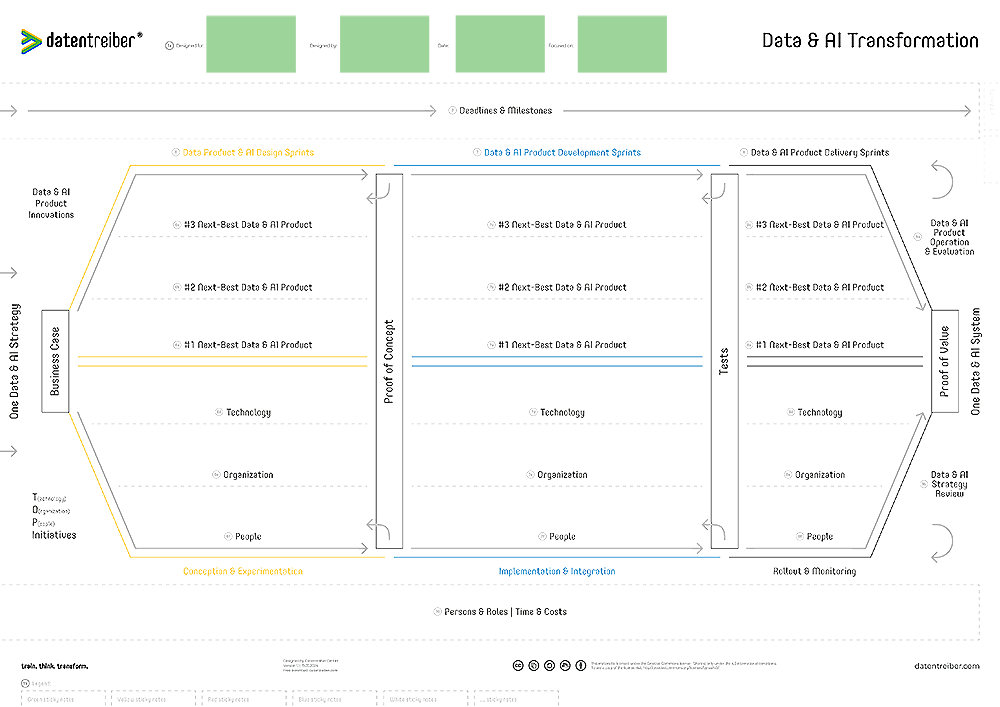
1a Header (Canvas 2)
The header defines the content of the canvas and should consist of the following information:
- Designed for: Which organization (company, department, team, etc.) does the content of the canvas concern?
- Designed by: Which organization (company, department, team, etc.) created the content?
- Date: When was the content created or last updated?
- Focused on: On which area/topic/case/etc. does the content of this canvas focus?
There should be no copies of the same canvas with identical headers, i.e., the header clearly identifies a version of the canvas (copy) and documents the current status of its content.
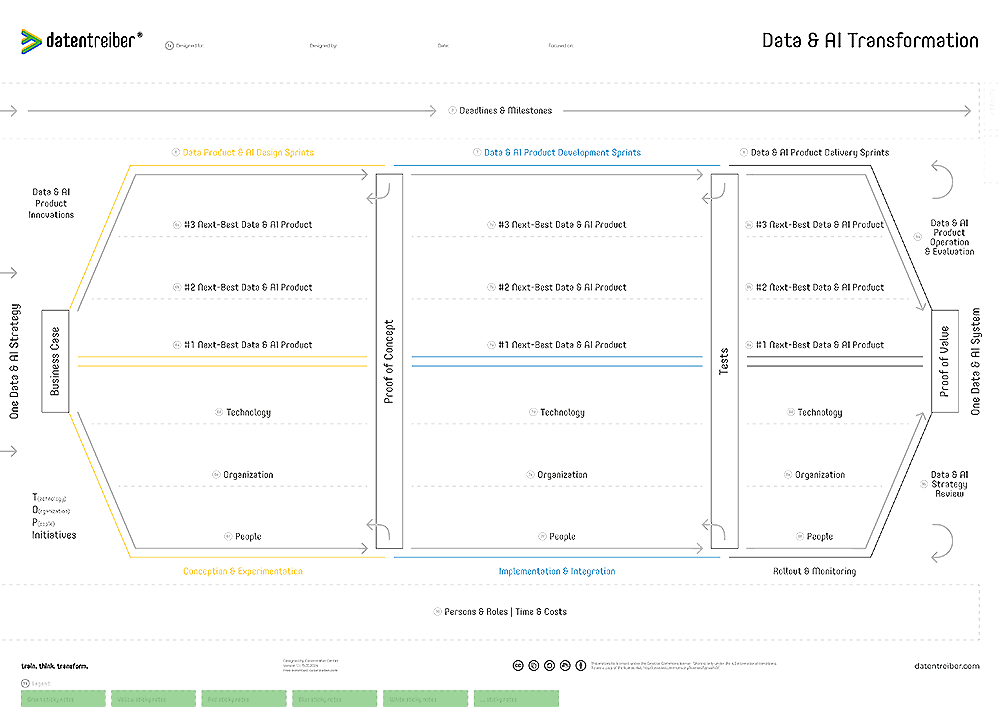
1b Footer (Canvas 2)
The footer explains the coloring of the sticky notes (and other formatting) on the canvas.
For each sticky note color, there should be an identically colored or formatted sticky note on the legend with a title explaining this specific sticky note category.
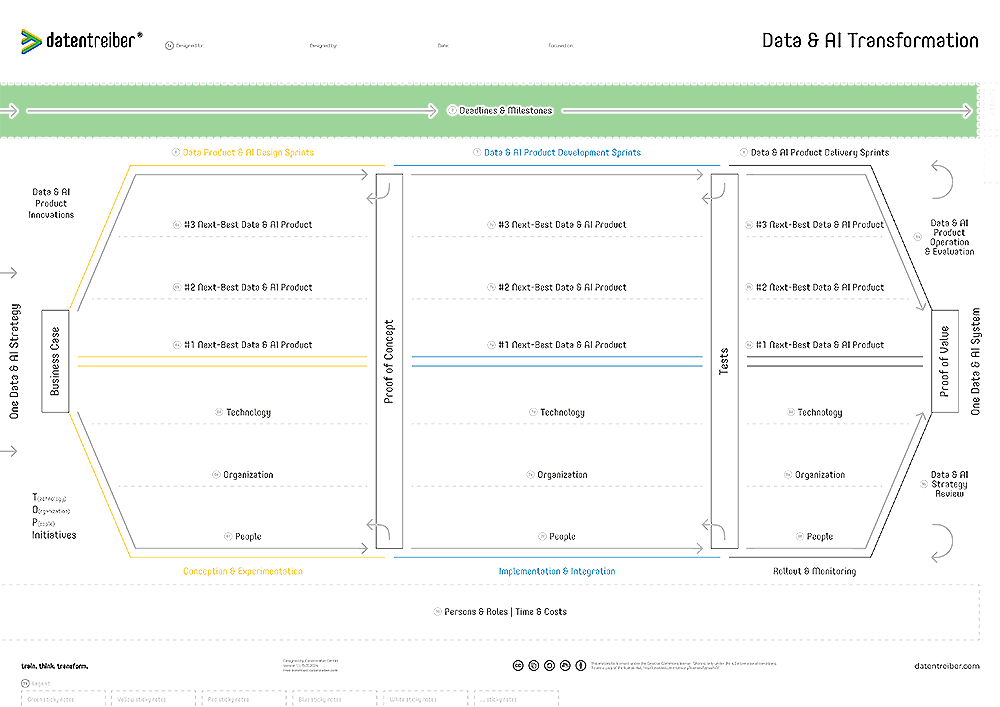
2 Deadlines & Milestones (Canvas 2)
Which milestones should be reached by which deadlines?
- Milestones are used to monitor progress, i.e., to determine whether you are on the right path and will reach your destination at the right time.
- Deadlines, i.e., a specific date or event, are set by which a milestone must be reached.
Milestones also serve to synchronize different projects, e.g., work on the data & AI products and work on the technological infrastructure, organizational structure, and personnel structure.
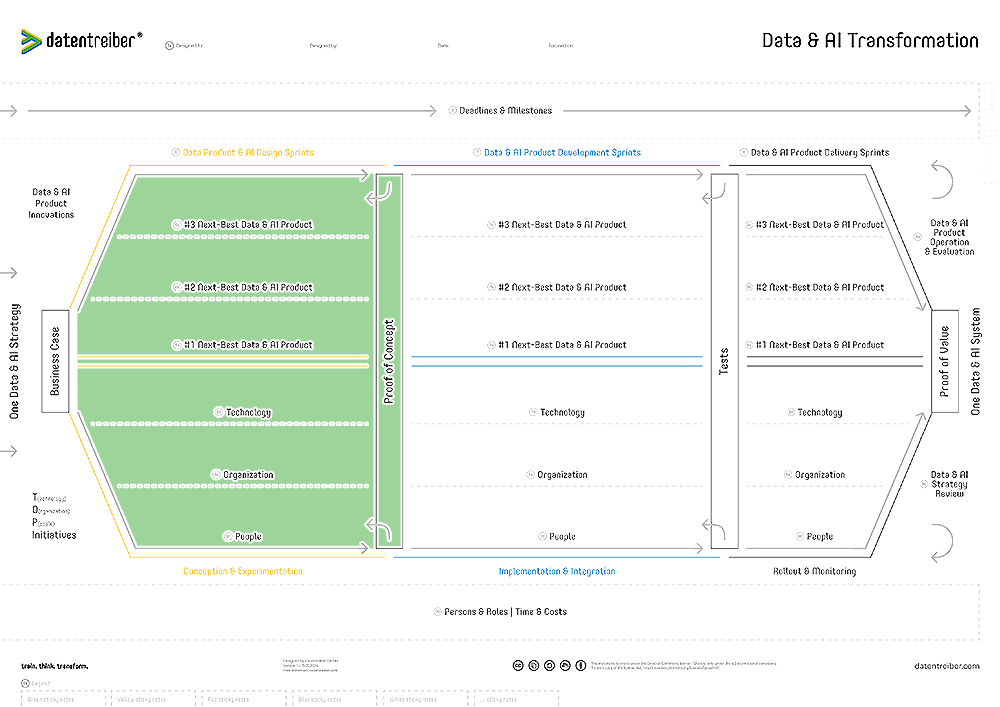
6 Data & AI Product Design Sprints (Canvas 2)
This is a placeholder text for 6 Data & AI Product Design Sprints in Canvas 2.
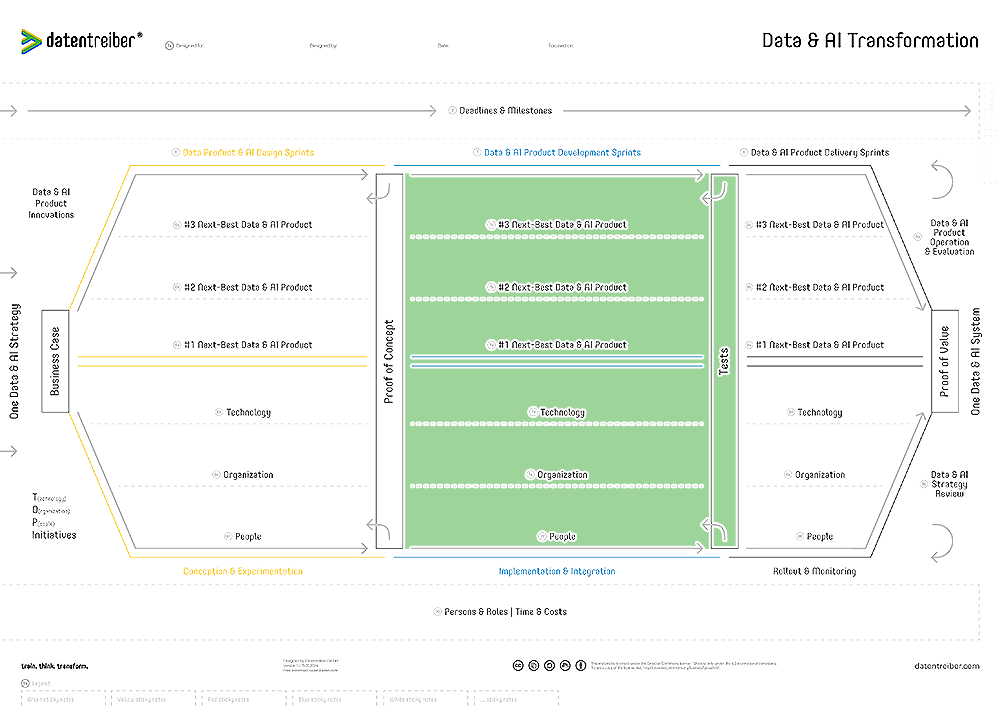
7 Data & AI Product Development Sprints (Canvas 2)
This is a placeholder text for 7 Data & AI Product Development Sprints in Canvas 2.
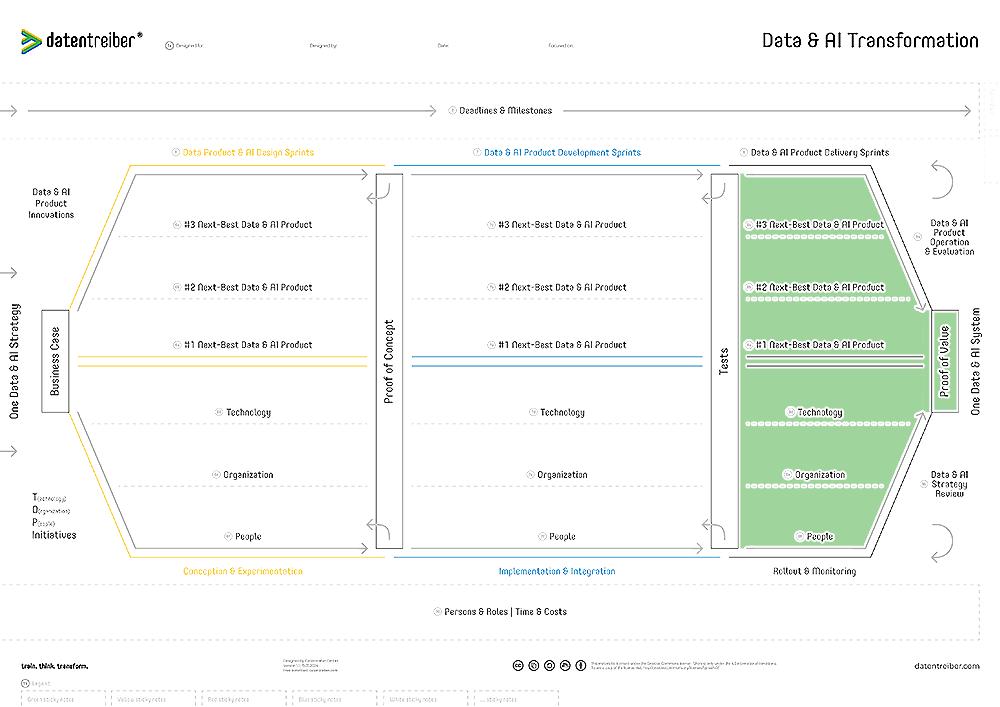
8 Data & AI Product Delivery Sprints (Canvas 2)
This is a placeholder text for 8 Data & AI Product Delivery Sprints in Canvas 2.
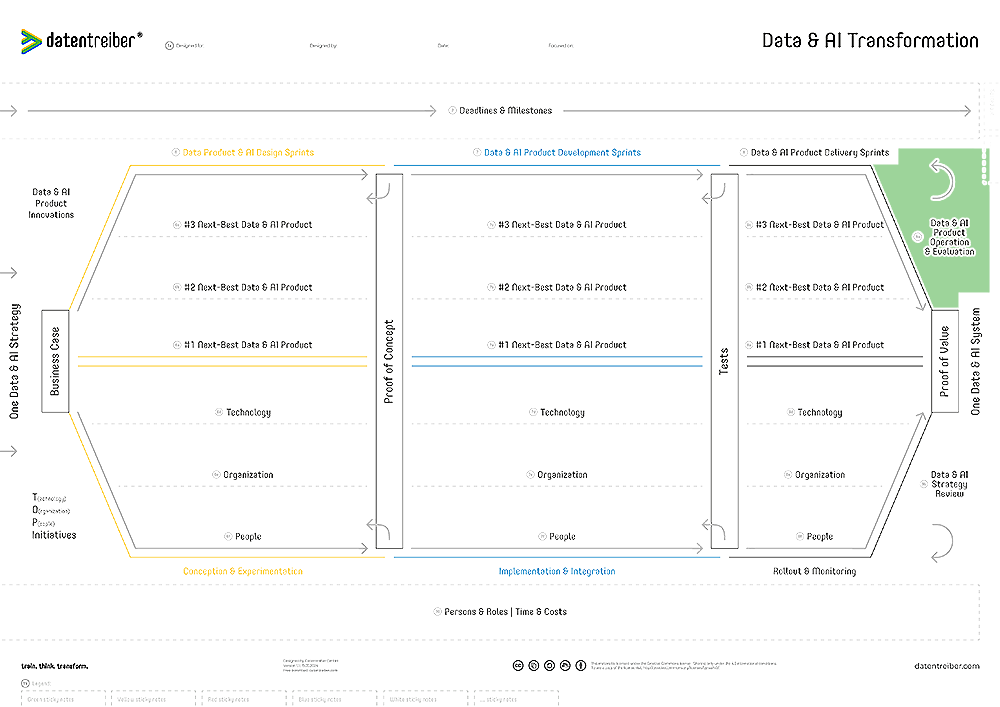
9a Data & AI Product Operation & Evaluation (Canvas 2)
This is a placeholder text for 9a Data & AI Product Operation & Evaluation in Canvas 2.
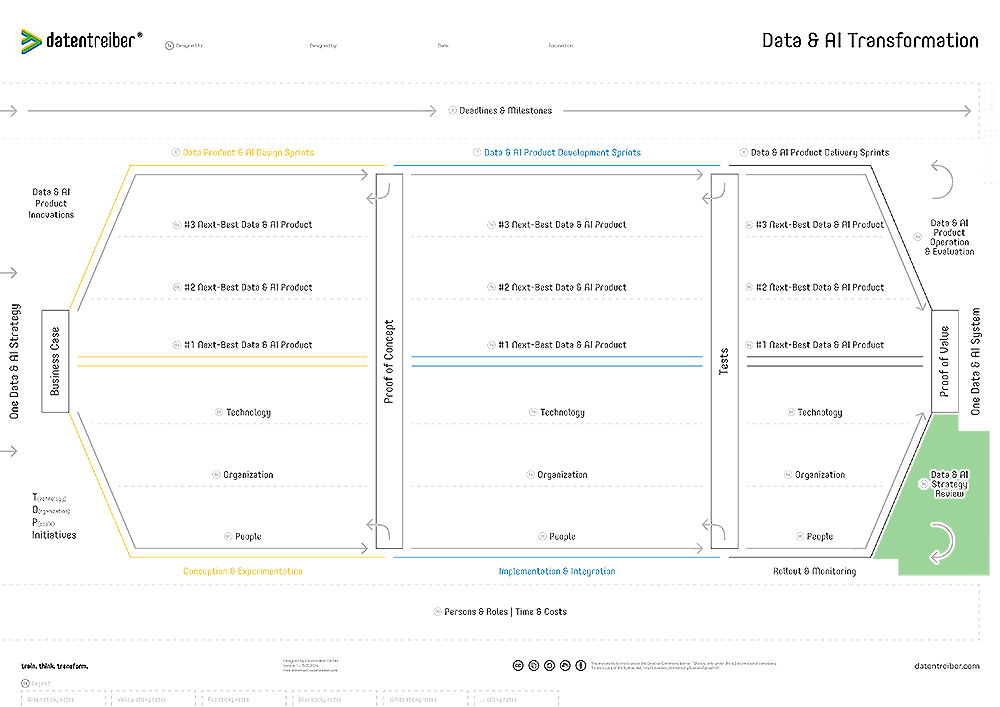
9b Data & AI Strategy Review (Canvas 2)
This is a placeholder text for 9b Data & AI Strategy Review in Canvas 2.
10 Persons & Roles / Time & Costs (Canvas 2)
Who is needed for the trainings and workshops, when, to what extent, and what costs are to be expected?
Design thinking is an interdisciplinary approach, requiring many different roles:
- Internal business managers
- Data and AI experts
- External workshop facilitators
- More specialized roles as needed
Those people should be T-shaped individuals, i.e., experts in their specific domain but open-minded and with common knowledge in adjacent areas.
Where Can I Find More Information?
- Find detailed tutorials and examples on how to use the canvas in the context of designing a fully integrated data & AI strategy in our Data & AI Design Bench.
- Data Thinker Group (LinkedIn)

