
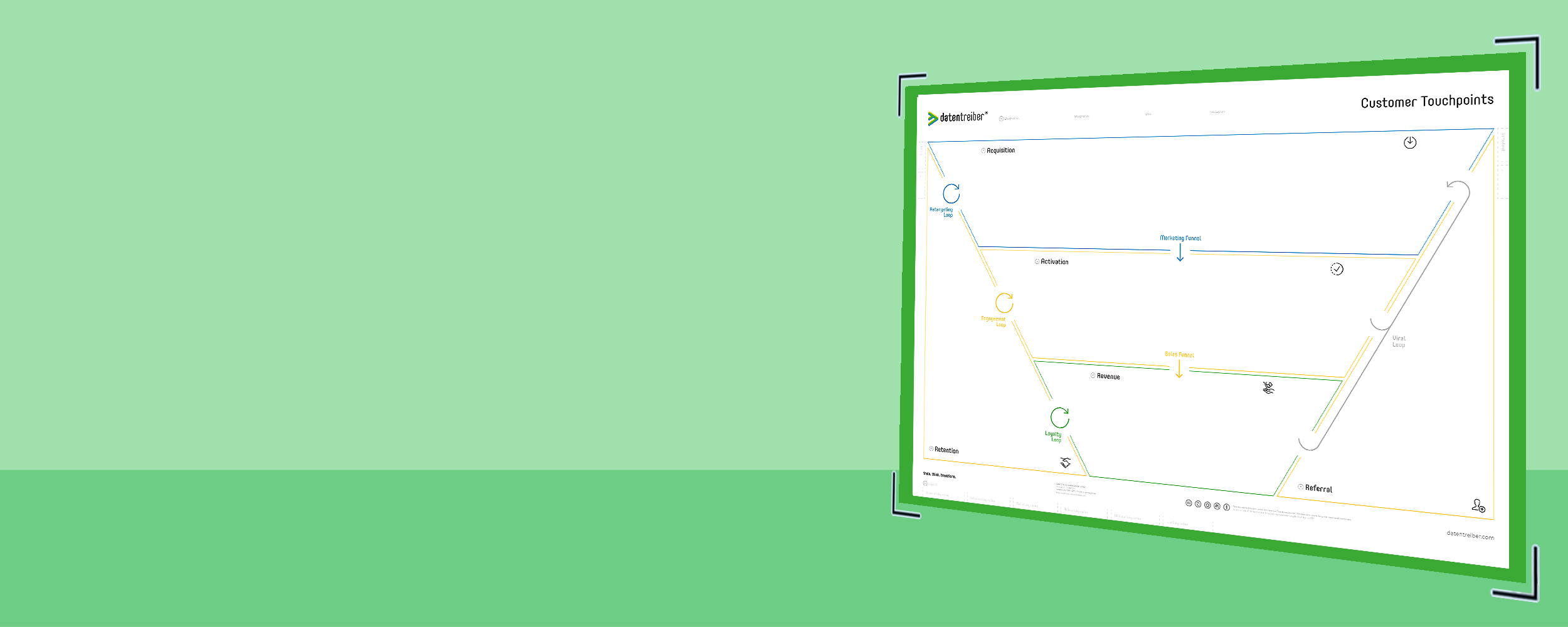
From Acquisition to Revenue
Customer Touchpoints Canvas
The Customer Touchpoints Canvas helps identify key customer touchpoints, analyze potential processes, and visualize successful customer journeys. Use it to evaluate and optimize customer paths effectively.
What is the Customer Touchpoints Canvas?
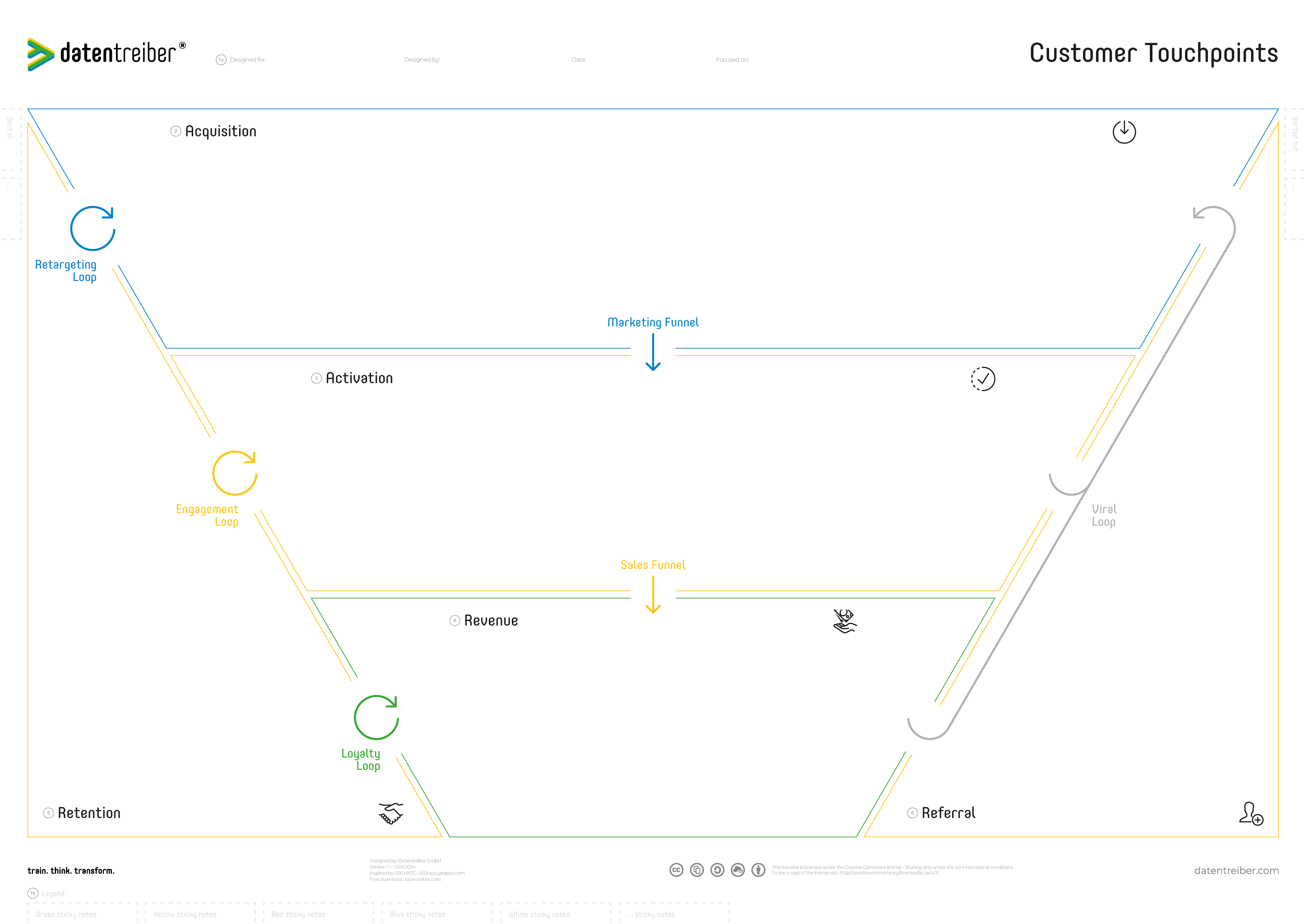
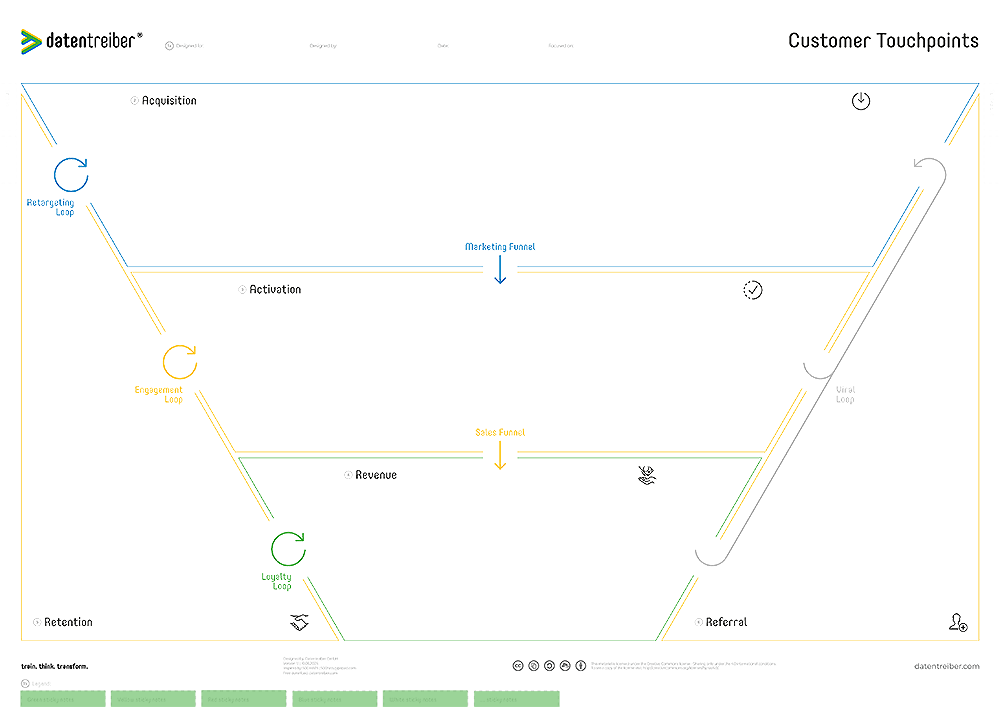
The Customer Touchpoints Canvas is a visualization and planning tool that helps you understand and optimize how customers interact with your business throughout their journey—from initially discovering your brand to becoming loyal advocates. By breaking down the customer experience into key phases (Acquisition, Activation, Revenue, Retention, and Referral), the canvas makes it easier to identify each touchpoint, evaluate the channels and content that guide customers through these stages, and highlight where to measure performance and gather data-driven insights.
- Acquisition: through which channels and throughout which campaigns do we create attention for our brands?
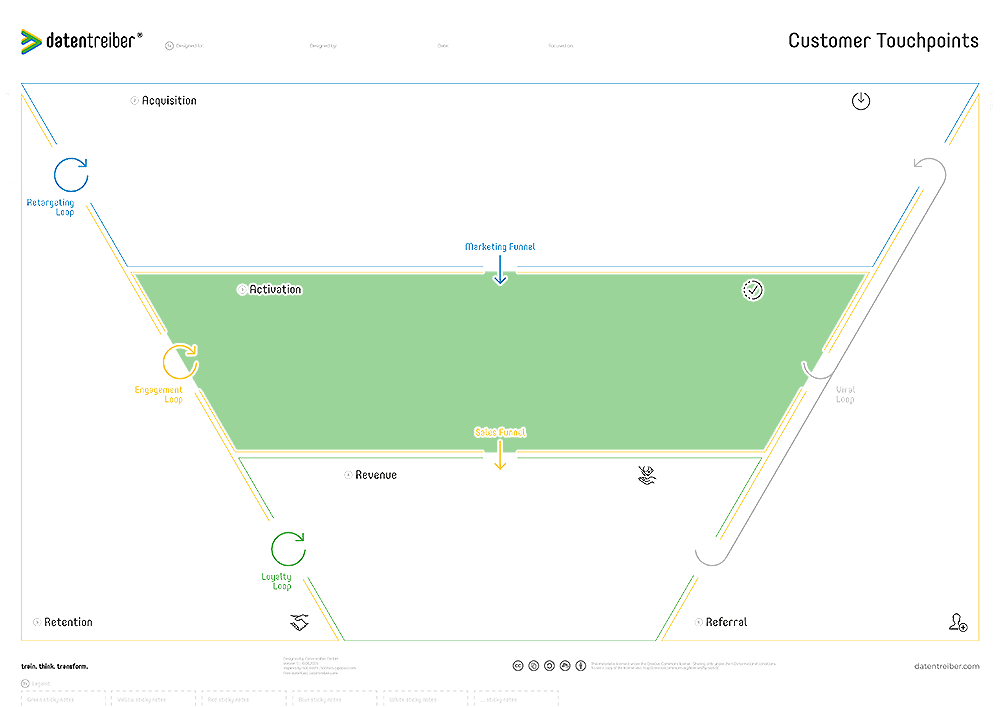
- Activation: at which customer touchpoints and with which offers do we convince the prospective buyers of our products and services?
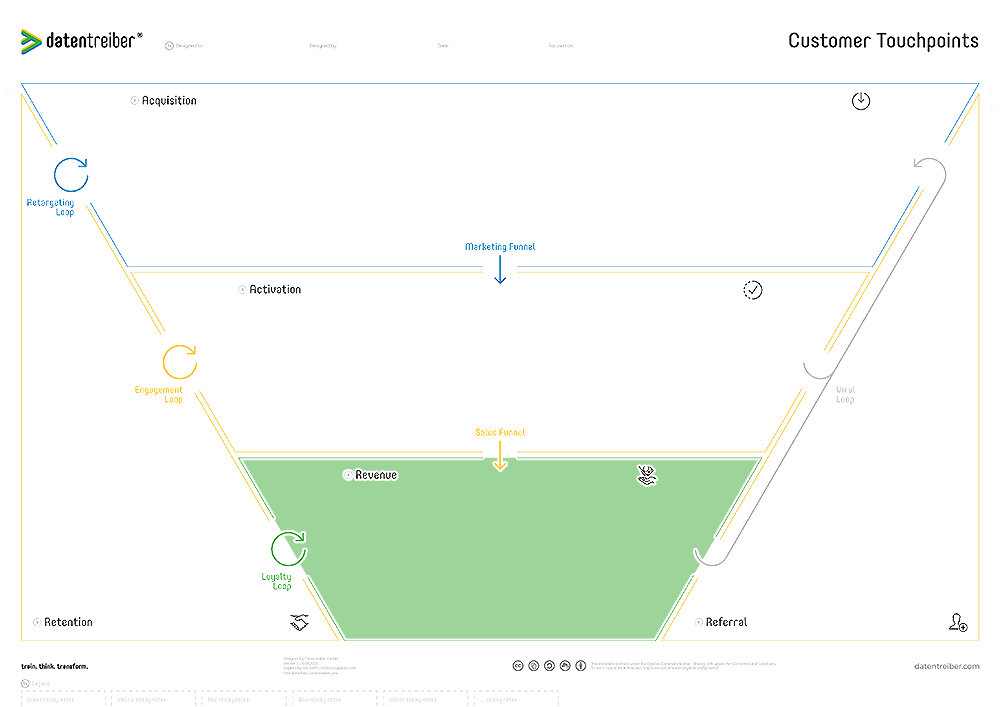
- Revenue: which are the relevant sales channels through which our customers acquire our products and services?
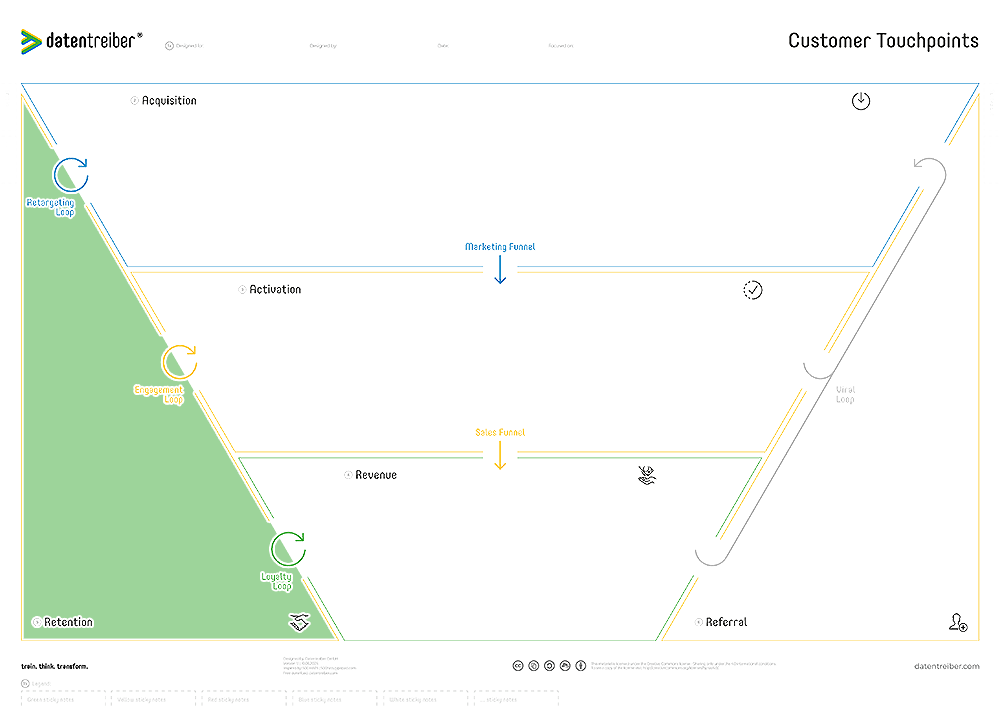
- Retention: how do we establish a long-term relation to the prospective buyers and customers?
- Referral: which possibilities and means do we offer prospective buyers and customers to share our offers with their contacts?
This approach encourages you to take the customer’s point of view, ensuring that each interaction aligns with their needs, expectations, and motivations. As a result, you can uncover logical gaps, remove friction, and improve consistency across online and offline channels. With the Customer Touchpoints Canvas, businesses can systematically refine their marketing and sales activities, enhance the user experience, and foster more enduring and rewarding customer relationships.
The Customer Touchpoints Canvas is available for free under a Creative Commons license: You may use and modify the canvas as long as you cite Datentreiber in particular as the source.
When to Use the Customer Touchpoints Canvas
The Customer Touchpoints Canvas is particularly useful in scenarios such as:
- Mapping and Improving the Customer Journey:
When you need to visualize how customers move through your brand experience, from initial awareness to ongoing loyalty, the canvas reveals opportunities for optimization at each step. - Planning Marketing and Sales Strategies:
If you are defining or refining marketing efforts—such as content, formats, and channels—this canvas helps align tactics with customer expectations, ensuring a coherent journey that drives engagement, conversions, and repeat business. - Setting Performance Indicators and Identifying Data Sources:
By pinpointing where customers interact with your business and how they progress from one phase to another, the canvas guides you in selecting meaningful performance metrics and understanding which tools and data points are necessary to track them. This data-driven perspective ensures that decisions are grounded in measurable outcomes. - Identifying Data & AI Use Cases:
If you want to explore how analytics or AI can enhance each stage of the customer journey—whether personalizing touchpoints during acquisition, predicting churn in retention, or automating follow-up in referral—the canvas helps you pinpoint precisely where AI-driven insights or capabilities can deliver the most impact.
Using the Customer Touchpoints Canvas enables organizations to approach the customer journey methodically, producing insights that support strategic planning and continuous improvement.
How Do I Use the Customer Touchpoints Canvas?
Customer touchpoints are points of contact between the company and its (current/potential) customers.
Customer touchpoints can be digital (e.g. online: the website) or completely analog (e.g. a customer conversation at the point of sale with a company employee). Each touchpoint fulfills a function from both the customer’s and the company’s perspective. For example, a customer may first want to be inspired by a new product, then get informed about the product and finally purchase the product.
The chain of customer contact points results in a customer journey, which may only take a few minutes, but can also last days, weeks, months or even years. The customer always has the option of interrupting, waiting and possibly continuing their journey at a later point in time, starting again or continuing elsewhere.
This results in a funnel: many contacts at the top, only a few customers at the bottom. The funnel can also be divided into a marketing and a sales funnel.
Customers assume different states along the funnel. The Customer Touchpoints Canvas uses the AARRR model to structure the customer journey. It is also known as the Pirate Model because the acronym sounds like a pirate call: “Aarrr!”
AARRR stands for:
Acquisition
Activation
Revenue
Retention
Referral
In contrast to the classic marketing and sales funnel approach, in which users are simply lost along the customer journey, the AARRR model attempts to reactivate users through early retention in order to monetize them later. Retargeting, engagement and loyalty loops are used for this purpose.
The AARRR model also provides for users who are not yet customers to recommend the brand, products and services and thus acquire new potential customers. This results in so-called viral loops.


1a Header
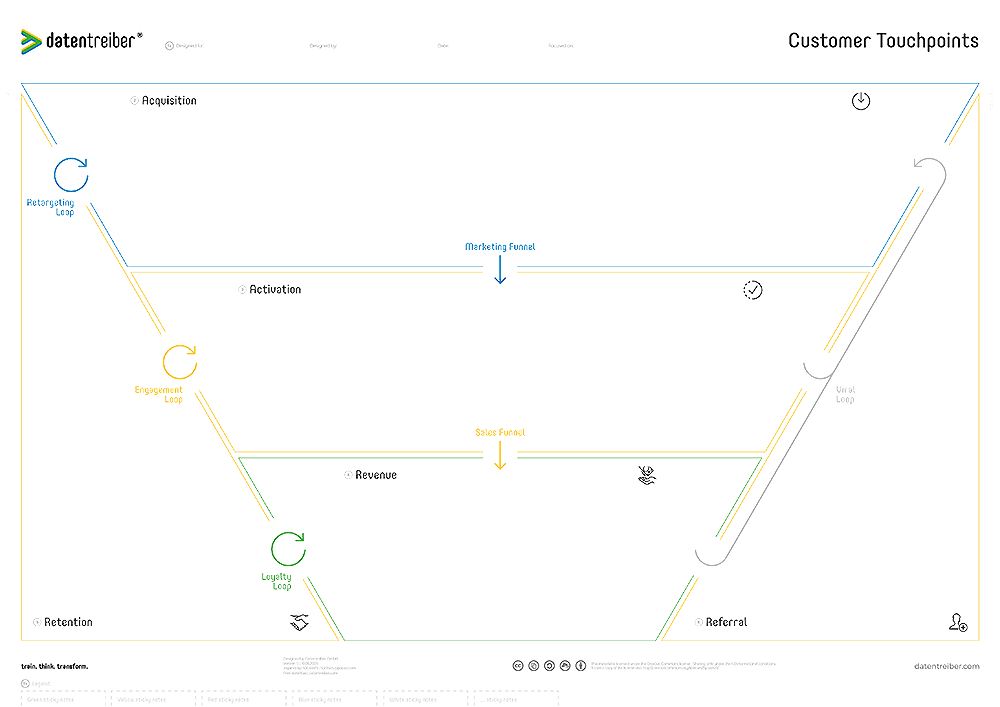
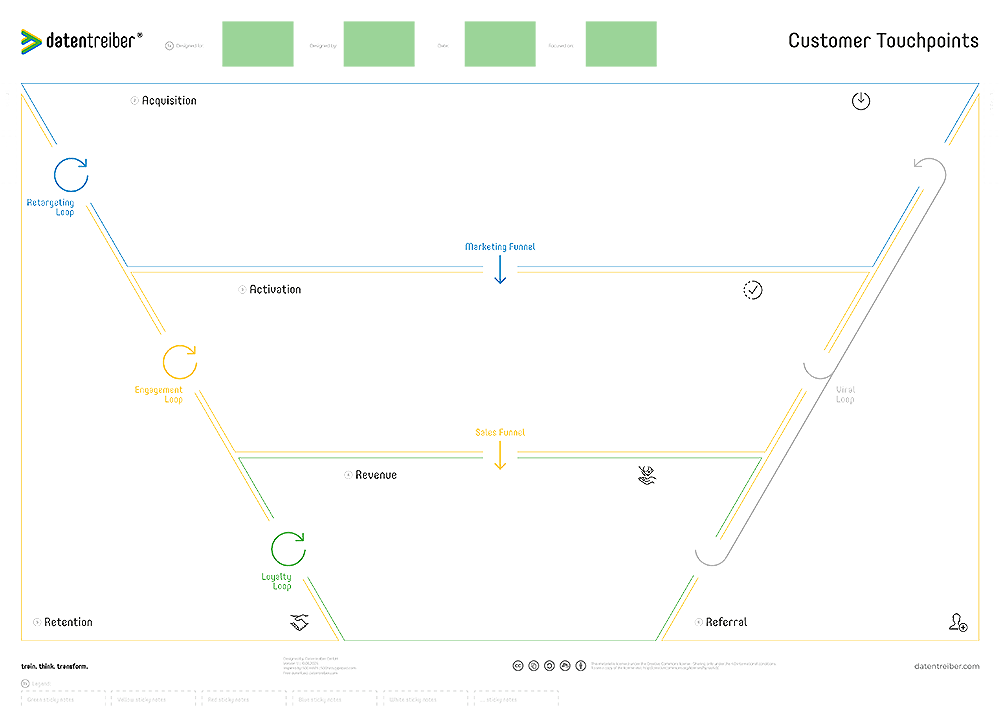
The header defines the content of the canvas and should consist of the following information:
- Designed for: Which organization (company, department, team, etc.) does the content of the canvas concern?
- Designed by: Which organization (company, department, team, etc.) created the content?
- Date: When was the content created or last updated?
- Focused on: On which area/topic/case/etc. does the content of this canvas focus?
There should be no copies of the same canvas with identical headers, i.e., the header clearly identifies a version of the canvas (copy) and documents the current status of its content.
1b Footer
The footer explains the coloring of the sticky notes (and other formatting) on the canvas.
For each sticky note color, there should be an identically colored or formatted sticky note on the legend with a title explaining this specific sticky note category.
2 Acquisition
Which channels do we use to acquire our leads and new customers?
Customer touchpoints for acquisition can be:
- Paid, owned, or earned media
- Online or offline channels
- Digital or classic advertising
The aim of acquisition is to attract attention to your own brand, products and services and to bring the user into the next phase of activation.
3 Activation
Which channels do we use to activate potential customers?
Customer touchpoints for activation could include:
- Online: website or mobile app
- Offline: in-store or at trade fairs.
- Third-party: e-commerce platforms
The aim of activation is to encourage customers to engage with the company’s brand, products, and services in an active way.
4 Revenue
Which channels do we use to generate revenue from our customers?
Customer touchpoints for activation could include:
- Online: website or mobile app
- Offline: in-store or at trade fairs.
- Third-party: e-commerce platforms
The aim of activation is to encourage customers to engage with the company’s brand, products, and services in an active way.
5 Retention
Which channels do we use to retain our (actual but also potential) customers?
Customer touchpoints for retention could include:
- Newsletter: Customers become subscribers.
- Social Media: Customers become followers.
- Loyalty programs: Customers become members.
The aim of retention is not losing current and potential customers, reactivating them regularly, informing them about new products, services and offers and generating follow-up sales. Additional customer data can also be acquired.
6 Referral
Which channels do we use to enable our customers to refer our brand, products, services, offers etc. to their friends, colleagues, peers etc.?
Customer touchpoints for referral could include:
- Word of mouth: storytelling, guerilla marketing and similar tactics
- Social Media: sharing buttons and viral campaigns
- Referral programs: incl. incentives e.g., discounts, cash rewards etc.
The aim of referral is to gain new customers or new prospects without having to acquire them via paid advertising. Recommendations also have a higher conversion rate.
Where Can I Find More Information?
- Find detailed tutorials and examples on how to use the canvas in the context of designing a fully integrated data & AI strategy in our Data & AI Design Bench.
- Messen Sie was zählt wo es zählt (Blog)
- Mit Design Thinking zur erfolgreichen Customer Journey (SlidesLive: Folien & Video)
- Design Thinking zur Optimierung der Customer Journey (SlideShare)
- Data Thinker Group (LinkedIn)

