

From Adaption to Transformation to Disruption
Growth Horizon Canvas
Using the Growth Horizons Canvas you can arrange innovations based on their marketability and technological maturity. The prioritization tool helps you to focus at the right point in time on the short-, mid- and long-term business ideas.
What is the Growth Horizons Canvas?
The Growth Horizons Canvas helps you position innovation ideas within a structured timeline, showing how they evolve from short-term improvements in known markets and technologies to long-term, disruptive solutions that depend on emerging domains and unproven technologies. By examining the perspective of a specific “Market Player”—the entity or organization observing the landscape—this canvas reveals how markets (or domains) and technologies intersect at different stages of development, offering clarity on when and where to invest in new business ideas.
Through three distinct horizons—H1 (Adaption), H2 (Transformation), and H3 (Disruption)—you can map each idea based on market familiarity and technological maturity. H1 focuses on immediate enhancements to the existing core business. H2 looks toward medium-term growth through markets and technologies the organization does not yet leverage. H3 envisions long-term possibilities where neither the market nor the technology is fully formed, highlighting higher risk but also the greatest potential impact.
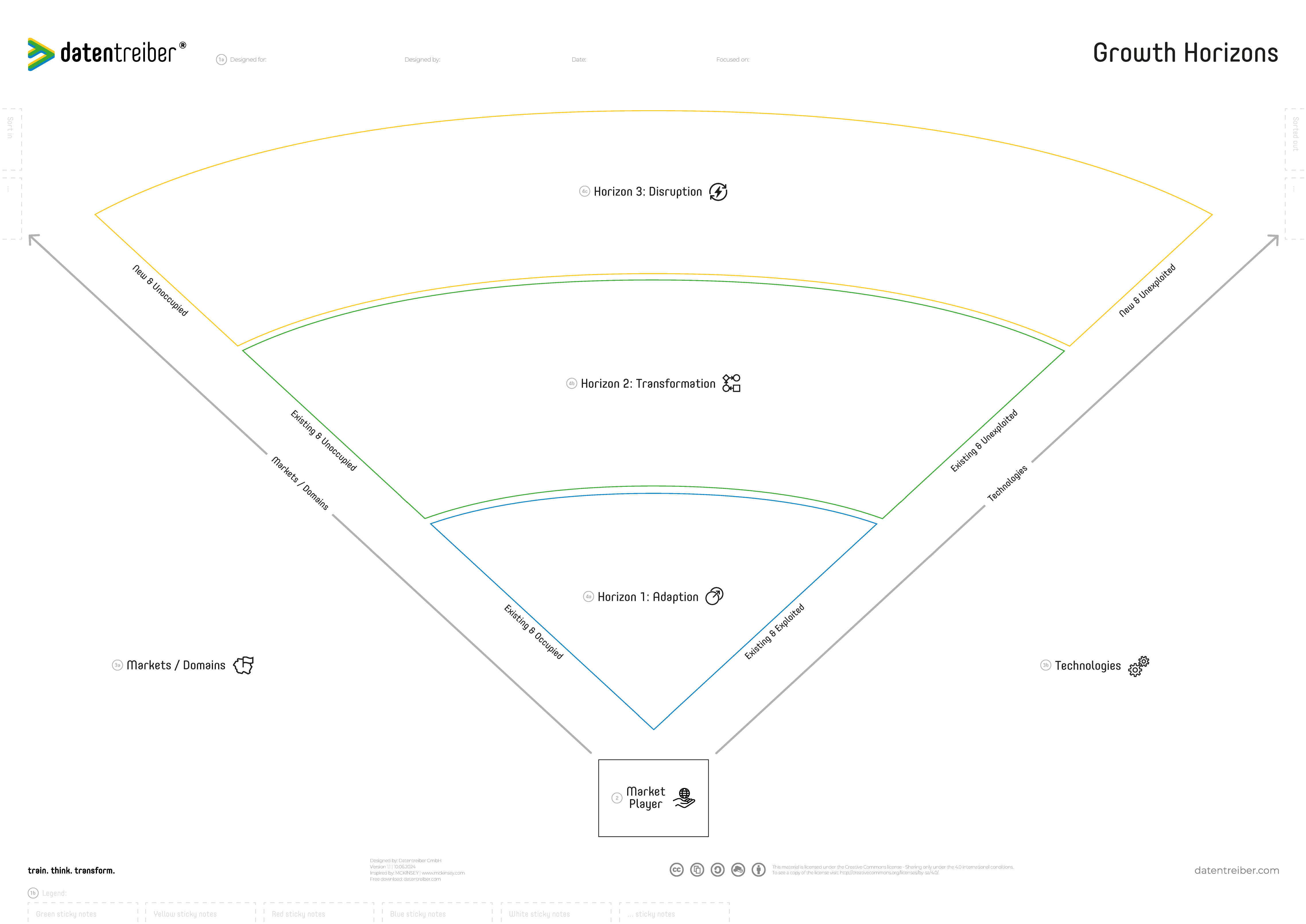
The Growth Horizons Canvas is available for free under a Creative Commons license: You may use and modify the canvas as long as you cite Datentreiber in particular as the source.
When to Use the Growth Horizons Canvas?
The Growth Horizons Canvas is particularly useful in scenarios such as:
- Early-Stage Innovation Planning:
When you have a range of new product or service ideas and need to understand how soon—and how realistically—they can be brought to market. In the context of data and AI, this means assessing whether you have (or can gather) the data required to develop meaningful AI or analytics solutions in the short term, and identifying which ideas need longer data collection or more advanced AI techniques. - Strategic Roadmapping:
To determine which innovations should be pursued in the short term to strengthen the core business, which should be prepared for mid-term rollout as markets and technologies mature, and which to keep as long-term bets on future disruptions. For data and AI projects, this also involves balancing quick wins (e.g., applying existing models to current data) against investing in emerging AI capabilities or new data sources that may only pay off in a later horizon. - Portfolio Management:
When balancing incremental improvements against ambitious, potentially game-changing ventures, the canvas helps maintain a healthy mix of short-, mid-, and long-term projects. In data-driven contexts, this includes deciding which AI-driven innovations can be implemented immediately using existing data, which require building up data pipelines over time, and which rely on future data collection or emerging AI technologies that aren’t market-ready yet.
By applying the Growth Horizons Canvas from the lenses of data & AI, you gain a clearer vision of the pathway from immediate initiatives to transformative opportunities, ensuring you allocate resources effectively, invest in the right data assets, and develop AI capabilities that support both near-term gains and future innovation.
How Do I Use the Growth Horizons Canvas?
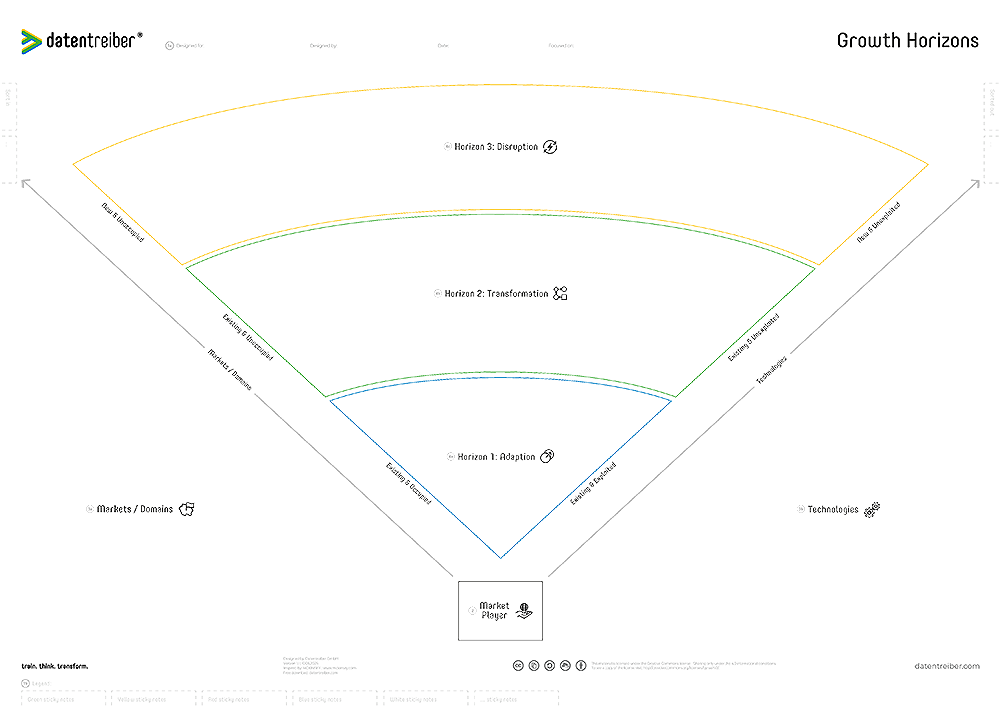
The Growth Horizons Canvas helps visualize and prioritize innovation ideas across different time horizons, considering both market (or domain) potential and technological maturity. By positioning each idea according to its alignment with existing or emerging markets and known or experimental technologies, you gain insights into how initiatives evolve from short-term improvements (H1) to mid-term transformations (H2) and long-term disruptions (H3).
A key aspect of this canvas is the Market Player—the perspective from which you observe and evaluate market/domains (to the right) and technologies (to the left). This vantage point helps frame your innovation portfolio relative to your current position and strategic ambitions. For instance, as a well-established company (the Market Player), you might explore known markets you already serve and technologies you have mastered in H1, while simultaneously scanning new domains and experimental technologies that fit into H2 and H3.
By structuring your growth opportunities in this manner, the Growth Horizons Canvas guides you in sequencing initiatives—focusing on what can be done now, what should be prepared for tomorrow, and what bets to place on the distant future. You clarify not only which ideas to pursue but also when and how to invest resources, ensuring that your innovation pipeline remains balanced and forward-looking.



The Canvas Sections
1a Header
The header defines the content of the canvas and should consist of the following information:
- Designed for: Which organization (company, department, team, etc.) does the content of the canvas concern?
- Designed by: Which organization (company, department, team, etc.) created the content?
- Date: When was the content created or last updated?
- Focused on: On which strategy field, innovation area, market perspective, or portfolio does the content of this canvas focus?
There should be no copies of the same canvas with identical headers, i.e. the header clearly identifies a version of the canvas and documents the current status of its content.
1b Footer
The footer explains the coloring of the sticky notes and other visual elements used on the canvas.
For the Growth Horizons Canvas, the legend can be used to clarify, for example:
- Different types of business ideas or initiatives
- Priorities, owners, or status information
- Additional visual markers used for clustering or evaluation
For each sticky note color or format, there should be an identically colored or formatted note in the legend with a title explaining its meaning.
2 Market Player
The Market Player defines the point of view from which the canvas is interpreted.
This field should name the organization, business unit, product area, or other entity whose current position serves as the reference for the analysis. All assessments on the canvas are relative to this Market Player: whether a market is considered existing or new, and whether a technology is considered known, applied, emerging, or unproven.
There should be one clearly defined Market Player per canvas so that all innovation ideas are assessed from the same strategic perspective.
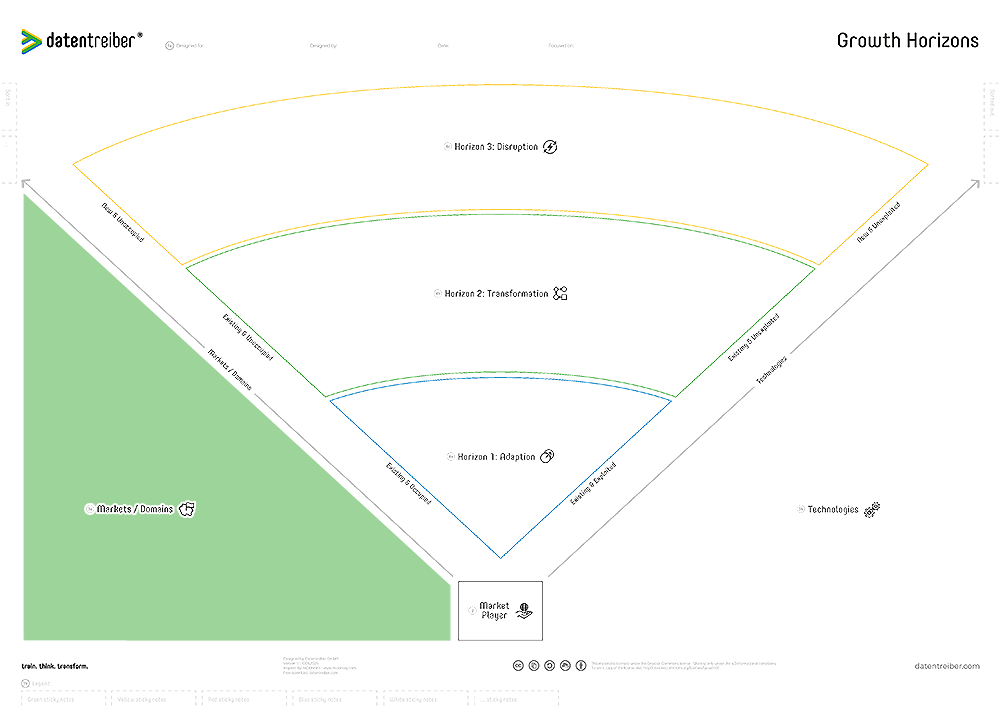
3a Markets / Domains
The Markets / Domains section describes the market environment in which innovation ideas are positioned.
It is used to distinguish whether an idea addresses:
- Existing and already occupied markets or domains
- Existing markets or domains in which the Market Player is not yet active
- New or still emerging markets or domains
This section helps teams assess how far an idea is from the current business environment of the Market Player. In some contexts, “domains” can also refer to customer groups, industries, business fields, or application areas.
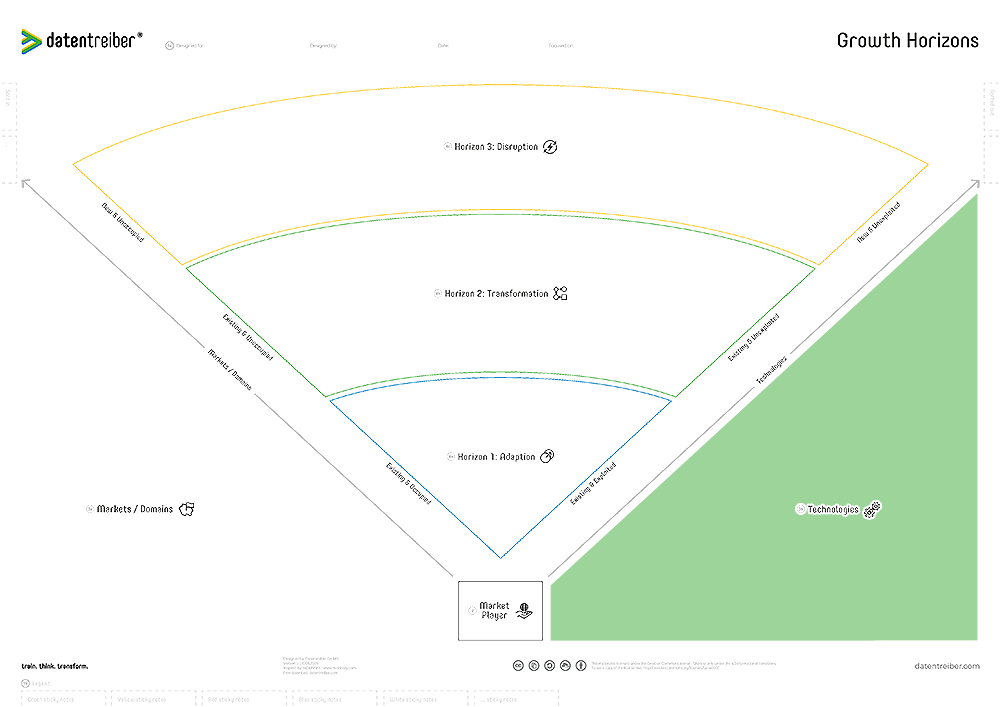
3b Technologies
The Technologies section describes the technological environment required to realize the innovation ideas.
It is used to distinguish whether an idea depends on:
- Existing and already applied technologies
- Existing technologies that are not yet used by the Market Player
- New, emerging, or not yet proven technologies
This section helps teams assess how mature and accessible the required technological capabilities are. It also highlights where capability building, experimentation, or further technological development may be needed before an idea can be realized.
4a Horizon 1: Adaption
Horizon 1 covers short-term ideas that strengthen, defend, or extend the current core business.
These ideas are typically located close to the Market Player in both dimensions: they address existing markets or domains and rely on existing, proven technologies. The goal is to adapt the business to current market and technology standards and to realize improvements with relatively low uncertainty.
Ideas in this horizon are often the most concrete and actionable and should usually receive the strongest execution focus in the near term.
4b Horizon 2: Transformation
Horizon 2 covers mid-term ideas that prepare the future core business.
These ideas typically move beyond the current position of the Market Player: they target markets or domains that already exist but are not yet served, and/or they require technologies that already exist but are not yet applied by the organization. The goal is to build the capabilities, market access, and experience needed for future growth.
Ideas in this horizon usually require preparation work such as concept development, market analysis, piloting, or prototyping before they can become part of the core business.
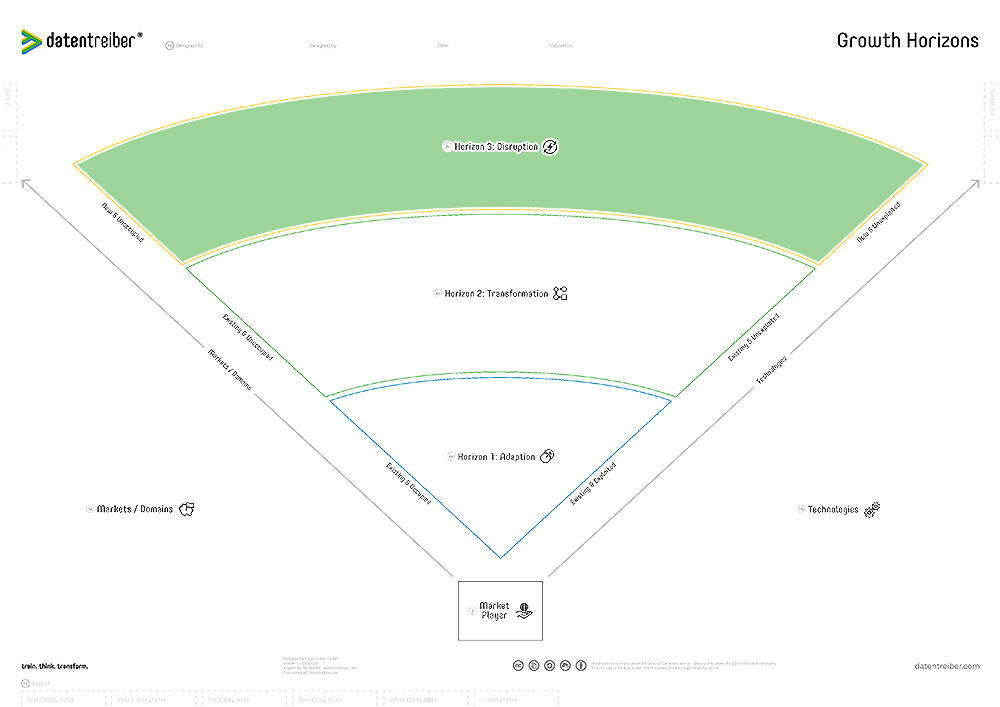
4c Horizon 3: Disruption
Horizon 3 covers long-term ideas with disruptive potential.
These ideas are furthest away from the current core business and are associated with the highest uncertainty. They may depend on not yet developed markets or domains, on immature or unproven technologies, or on a combination of both. At the same time, they may offer the greatest strategic upside and the potential to fundamentally reshape or replace the existing business.
Ideas in this horizon should not usually be managed like short-term initiatives. Instead, they should be explored, monitored, and developed through strategic observation, experimentation, and early conceptual work until markets and technologies become mature enough.
Where Can I Find More Information?
- Find detailed tutorials and examples on how to use the canvas in the context of designing a fully integrated data & AI strategy in our Data & AI Design Bench.
- The Growth Horizons Canvas is based on the Three Horizons Framework by McKinsey.
- Data Thinker Group (LinkedIn)

